
Consciousness is not a product of the brain. It does not arise from chemical reactions, does not depend on synapses, and does not switch off when the body stops functioning. This is the vision of the Upaniṣads — and it completely changes how you understand yourself.
In the West, the investigation of consciousness starts from an assumption: it is a phenomenon. Something that happens. A by-product of neuronal activity. Philosophers call this "the hard problem of consciousness" — how does inert matter generate subjective experience? Neuroscience maps correlations between brain states and experiences, but it never explains how atoms and molecules generate the experience of seeing red, feeling pain, or understanding a sentence.
The Upaniṣads resolve this problem in a radical way: consciousness is not a phenomenon. It is not produced by anything. It is the fundamental reality of everything that exists.
Cit — the nature of consciousness
In Vedānta, consciousness is called cit. And cit is not a quality you possess — it is what you are. The difference is enormous.
When I say "I have consciousness," I am treating consciousness as an attribute, something that belongs to a separate being. But the Upaniṣad reverses this: you are consciousness that appears to have a body, a mind, a story.
The Māṇḍūkya Upaniṣad opens with one of the most direct statements in all of Vedic literature: "ayam ātmā brahma" — this ātmā is Brahman. What experiences, what observes, what is conscious right now — that is not different from absolute reality. It is not a part of it, not a spark of it. It is it, entirely.
The Kena Upaniṣad asks a question that seems simple but destabilizes everything: "By whom directed does the mind go to its object?" Who makes the mind function? Who makes the eyes see? The Upaniṣad's answer: that by which the mind thinks, but which the mind cannot think — that is Brahman. Consciousness is not an object of knowledge. It is the subject that makes all knowledge possible.
The brain does not produce consciousness
The idea that the brain produces consciousness is an assumption, not a conclusion. No experiment has ever demonstrated how matter generates subjective experience. What science shows is correlation: when certain brain areas are active, certain experiences happen. But correlation is not causation.
The Upaniṣads offer a powerful analogy. Think of a mirror. The mirror reflects your face, but it does not create your face. If you break the mirror, your face continues to exist. In the same way, the brain and the mind are instruments that reflect consciousness — they do not produce it.
The Bṛhadāraṇyaka Upaniṣad says: "vijñānam ānandam brahma" — Brahman is consciousness and fullness. Consciousness does not depend on an instrument to exist. It exists by itself. The instruments — body, mind, senses — depend on it.
When you sleep deeply, without dreams, the brain continues functioning. But you are not "conscious" of anything. Has consciousness disappeared? No. What disappeared was the instrument of manifestation — the active mind. You continue to exist, continue to be consciousness. So much so that when you wake up you say: "I slept well." Who slept well if there was no mind to register it?
Ātmā — pure consciousness
Ātmā is the technical term for what you really are. Not the body, not the mind, not the emotions, not the biography. Ātmā is pure consciousness — without form, without limit, without birth, without death.
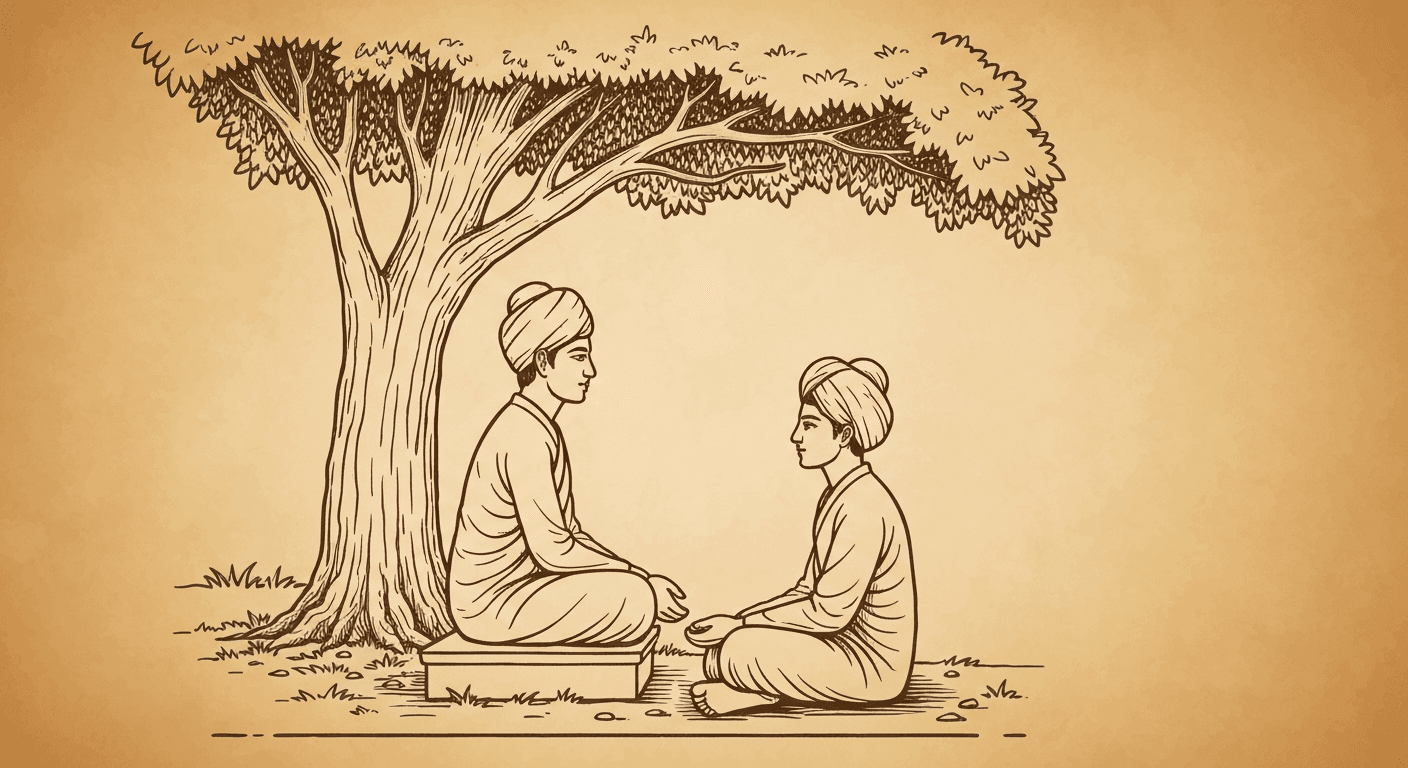
The Chāndogya Upaniṣad presents the most well-known teaching: "tat tvam asi" — you are that. The teacher Uddālaka tells his son Śvetaketu: that subtle reality which sustains everything, which is the essence of everything — you are that. You will not become it. You already are.
This is not a mystical experience for a chosen few. It is a fact about your nature that can be understood. The tradition of Vedānta exists precisely for this — a systematic method of inquiry that leads to the clear understanding that consciousness is not something you have, but something you are.
Practical implications
If consciousness is my nature, and not a product of the body, several things change.
The fear of death changes. Death is the end of the body, not the end of me. This is not belief — it is the logical conclusion of understanding that consciousness does not depend on the body. The Kaṭha Upaniṣad is clear: "na jāyate mriyate vā" — ātmā is not born and does not die.
The search for completeness changes. If I am consciousness — which by definition is full, without lack — then the feeling of incompleteness does not come from my nature, but from my ignorance of it. I do not need to acquire anything to be complete. I need to understand what I already am.
The relationship with the mind changes. The mind comes to be seen as an instrument, not as "me." Thoughts, emotions, memories — all of this happens in me, but is not me. This is not dissociation. It is clarity. And this clarity is the foundation of all real psychological freedom.
---
*The Upaniṣads do not ask you to believe. They ask you to investigate. And the investigation begins with a simple question: who is conscious right now?*
Want to study Vedanta in depth?
Join a Study Group →