
The Māṇḍūkya Upaniṣad shows that you already experience limitless reality every night in deep sleep -- you just don't know it.
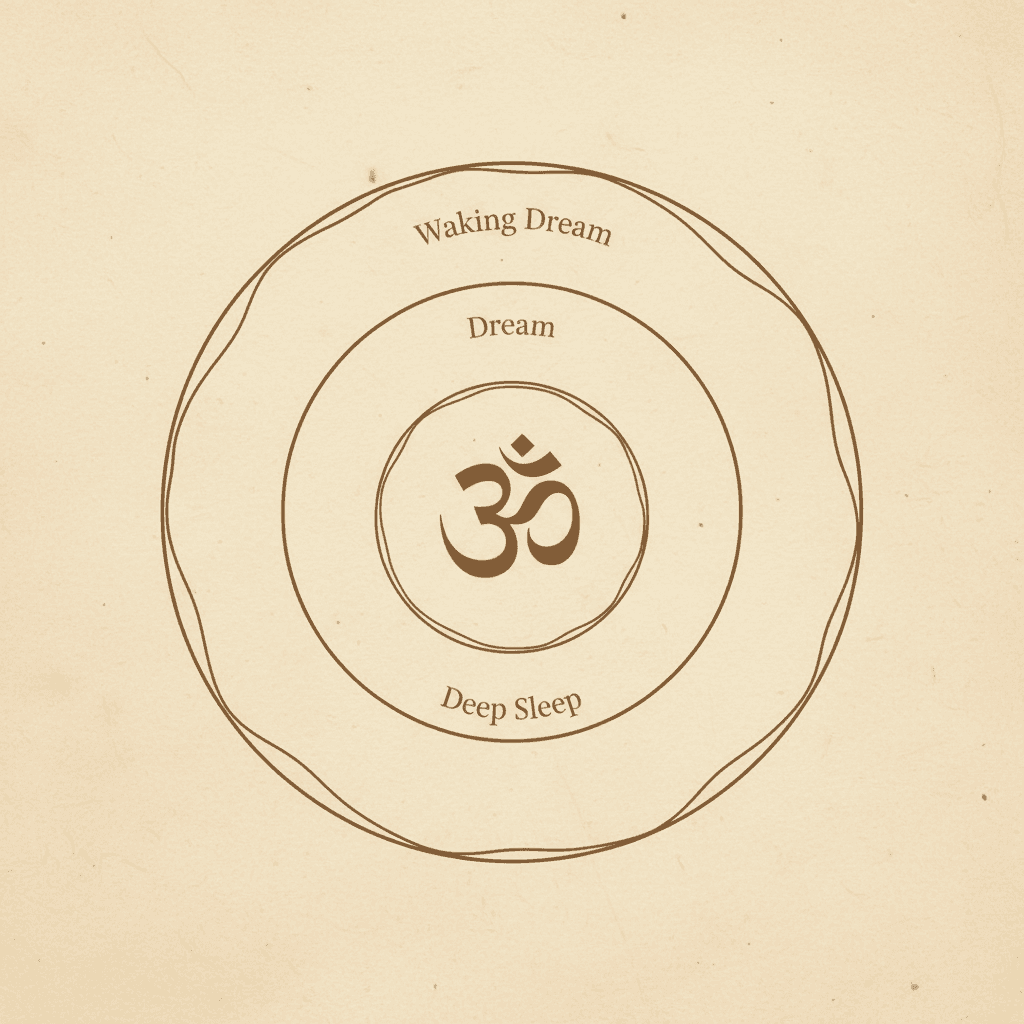
The Māṇḍūkya is the shortest of the principal Upaniṣads -- only 12 mantras. But Gauḍapāda (the guru of Śaṅkarācārya's guru) wrote a kārikā of 215 verses on it. And tradition says: "If someone can only study one Upaniṣad, let it be the Māṇḍūkya." In 12 verses, it delivers the core of Vedānta.
The method is brilliant. Instead of starting with abstract concepts, the Māṇḍūkya analyzes something you experience every day: the three states of experience.
First state: jāgarita (waking)
When you're awake, there's a world "out there" and an "I" in here. Subject and objects. You perceive through the senses, act through the body, think through the mind.
The Upaniṣad calls the self of this state Vaiśvānara -- the one who operates in the shared world. This is the state most people consider "real." What's awake is true; the rest is "just a dream" or "blackout."
Is it?
Second state: svapna (dream)
In dreams, you also experience a world. There are objects, people, spaces, emotions. The mind creates everything -- scenery and character. You feel real fear, real pleasure, real surprise. While the dream lasts, you don't question its reality.
The self of dream is Taijasa -- the luminous one, because the mind illuminates its own creation without needing external light.
The Māṇḍūkya's question is this: if the dream seems as real as waking while it happens, what guarantees that waking isn't another type of dream? Not as metaphor. As serious investigation.
Third state: suṣupti (deep sleep)
Here is the most revealing state -- and the most neglected.
In deep sleep, there is no world. No objects. No thoughts. Not even the sense of "I" as an individual. Mind, senses, ego -- everything is suspended.
And yet, you continue to exist. How do we know? Because you wake up and say: "I slept well, didn't notice anything." Who noticed that they noticed nothing? Who was there?
The self of deep sleep is Prājña -- the one who is pure cognition, without objects. It is described as ānandamaya -- full of bliss. In deep sleep, there are no problems. No lack. There is total peace.
This is experiential data, not theology. Every human being experiences suṣupti every night. And every night, the evidence is there: you exist without body, without mind, without world -- and you are at peace.
The "fourth": turīya
The Māṇḍūkya then reveals: these three states -- waking, dream, deep sleep -- are appearances in something that runs through all of them. That something is turīya (literally, "the fourth").
But turīya is not really a fourth state alongside the other three. It is the ground of the three. It is pure consciousness -- [ātman](/blog/atman-o-ser-verdadeiro-vedanta) -- which is equally present in waking, dream, and deep sleep.
In waking, turīya is present as the consciousness that illuminates external objects. In dream, turīya is present as the consciousness that illuminates internal objects. In deep sleep, turīya is present as the consciousness that illuminates... nothing. And continues being consciousness.
Turīya is not an experience. It is not an altered state. It is you -- the subject who remains identical through all states.
Oṃ and the three states
The Māṇḍūkya maps the three states to the three mātrās (measures) of the [mantra](/blog/mantra-poder-som-vedanta) Oṃ:
A (akāra) -- corresponds to waking (Vaiśvānara) U (ukāra) -- corresponds to dream (Taijasa) M (makāra) -- corresponds to deep sleep (Prājña)
And the silence after Oṃ -- amātra -- corresponds to turīya. Silence is not the absence of sound. It is that in which sound appears and disappears.
When you chant Oṃ with this understanding, the mantra ceases to be sonic and becomes contemplative. Each part points to a dimension of your experience. And the silence points to who you are.
Why this matters
The brilliance of the Māṇḍūkya is that it uses your own experience as laboratory. You don't need to believe anything. You need to observe.
Observe waking: there is a world and a subject. Observe dream: there is another world and the same subject. Observe deep sleep: there is no world and the subject continues.
The conclusion is inevitable: you do not depend on the world to exist. The world depends on you -- on the consciousness that you are -- to appear.
This is the teaching of Vedānta in its most distilled form. It is not mysticism. It is rigorous experiential analysis. And the conclusion changes everything: you are not the body that sleeps and wakes. You are the [consciousness](/blog/consciencia-segundo-upanishads-perspectiva-vedica) in which sleeping and waking happen.
Turīya is not something to be achieved. It is something to be recognized. You already are turīya -- always have been. The Māṇḍūkya simply points to what you already are.
Want to study Vedanta in depth?
Join a Study Group →