
*Based on the class "Stories from the Vedic Tradition -- Shiva," with Jonas Masetti*
---
There is a story in the Śiva Purāṇa that moved me in ways I did not expect. And I am learning not to underestimate these narratives -- they look like distant myths, but when you understand what they are saying, it is as if they are talking about your life.
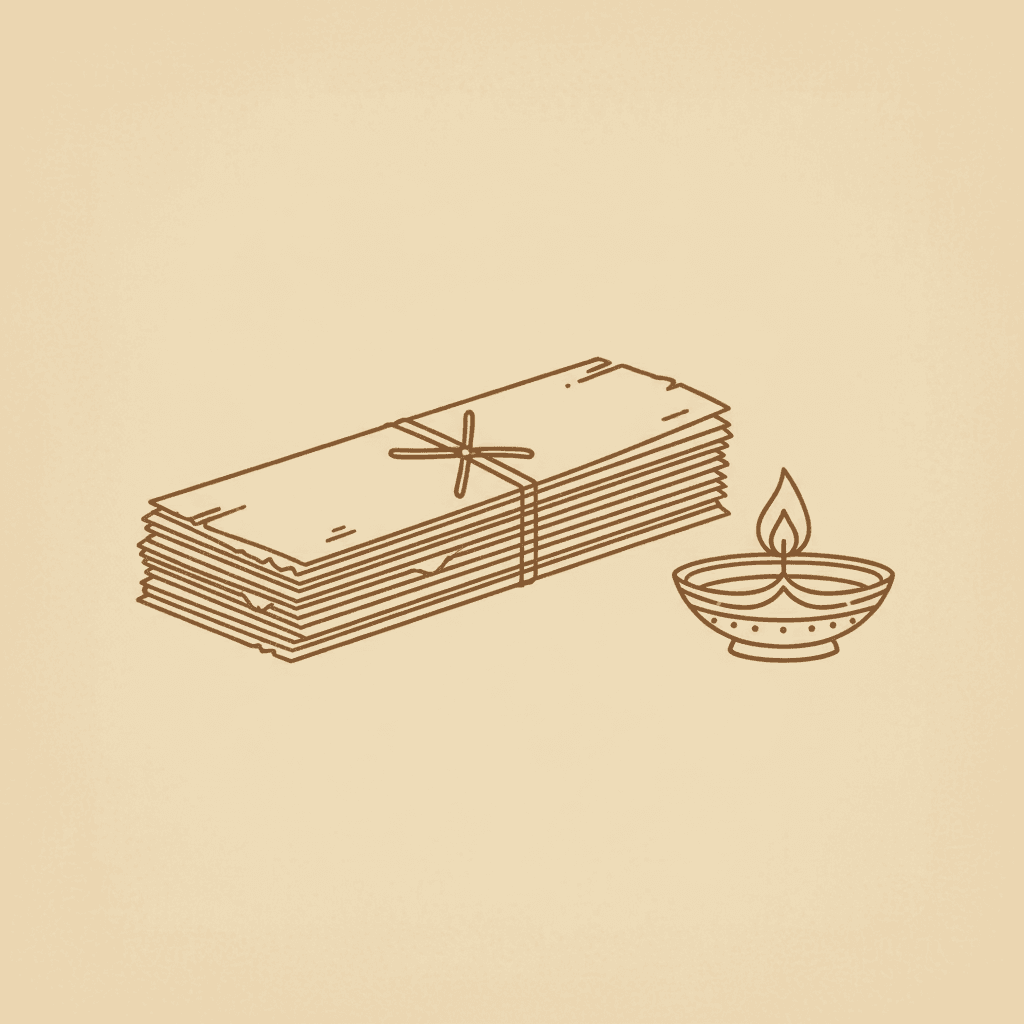
The Śiva Purāṇa is a massive work from the Vedic tradition. To give you an idea, the Odyssey has 12,000 verses. The Śiva Purāṇa once had 100,000 -- and even summarized, it has 24,000. Twice the Odyssey. And each Purāṇa tells the story of creation from the perspective of a specific deity.

The beginning of everything
The narrative starts like this: in the beginning, everything was in an unmanifest state, indistinguishable. It was neither hot nor cold, had no end nor beginning -- like deep sleep. Then waters appeared everywhere, and from them emerged Viṣṇu, immense, who lay upon the waters and slept. From his navel a giant, brilliant lotus was born. And on one of the petals of that lotus appeared Brahmā.
The first thing Brahmā does? Ask: "Where am I? Who am I? What is my role here?" -- exactly the existential questions many of us ask when the process of self-knowledge begins.
And what does Brahmā decide to do? Go out exploring the lotus in search of answers. Which is what we do too -- read a book on Kabbalah, watch a Vedānta lecture on YouTube, do yoga, go to a mindfulness retreat. And Brahmā explores for 100 years. Does not find the answers. Goes back another 100 years along the same path. Also does not find them. But the journey is not for nothing -- it all blesses the path.
The infinite līṅga
When Brahmā finally rests and receives the instruction to do tapas (disciplined spiritual practice), he studies for 12 years. And here is a beautiful detail: 12 years is the time the tradition prescribes for deep study of any subject -- the same cycle of Jupiter (Bṛhaspati) passing through the 12 astrological houses.
After the tapas, Viṣṇu appears and calls Brahmā "son." Brahmā takes offense. They start fighting. And in the middle of the fight, a brilliant līṅga appears -- a symbol without defined form that is the limitless nature of reality.
They try to find the top and bottom of this līṅga. They walk for 4,000 years. They cannot find them. Because this reality is free of limitation. You cannot reach the infinite by adding one plus one.
When they finally give up and pray, Śiva appears and says: "The three of us are parts of one same reality. Brahmā creates, Viṣṇu sustains, and I destroy."
The poison and Nīlakaṇṭha
But the part that touched me most is the story of the churning of the ocean of milk. When devas and asuras churn the ocean, wonderful things emerge -- like the process of personal transformation itself, where many blessings appear. But at a certain point, a terrible poison comes out.
Jonas explains that this is natural: in the process of self-knowledge, contents of the unconscious come to the surface. Blind spots appear. And if we do not deal with this with support -- from a traditional structure, from friends, from therapy -- we end up hurting the people around us.
Śiva drinks the poison. Pārvatī holds his throat, neutralizing the poison right there. That is why he is called Nīlakaṇṭha -- the blue-throated one.
Śiva's energy is not one of violent destruction. It is one of neutralization. The ego does not need to be destroyed. It needs to be neutralized -- like a poison that can no longer spread.
Dakṣiṇāmūrti -- the first teacher
And there is yet another side of Śiva that usually stays hidden: Dakṣiṇāmūrti, the first teacher. It is the form of Śiva that transmits knowledge about the reality of what we are. The lineage of teachers begins with him.
Jonas says something that marked me: when we are firm in wanting to grow and transform, we see Dakṣiṇāmūrti in everyone -- because there is always something to learn from people. Sometimes we are praying and asking for growth, and the answer comes from the mouth of the person who lives with us. But if we do not have this in mind, we miss the opportunity.
Śiva is good. The very translation of the word means "that which is good, auspicious." And perhaps that is the most beautiful lesson of this story: transformation can be intense, but its nature is auspicious.
---
*What changes when you stop fighting the poison and learn to neutralize it?*
Want to study Vedanta in depth?
Join a Study Group →