
Yoga means "connection" or "integration" -- and multiple paths exist because different types of people, temperaments, and needs exist.
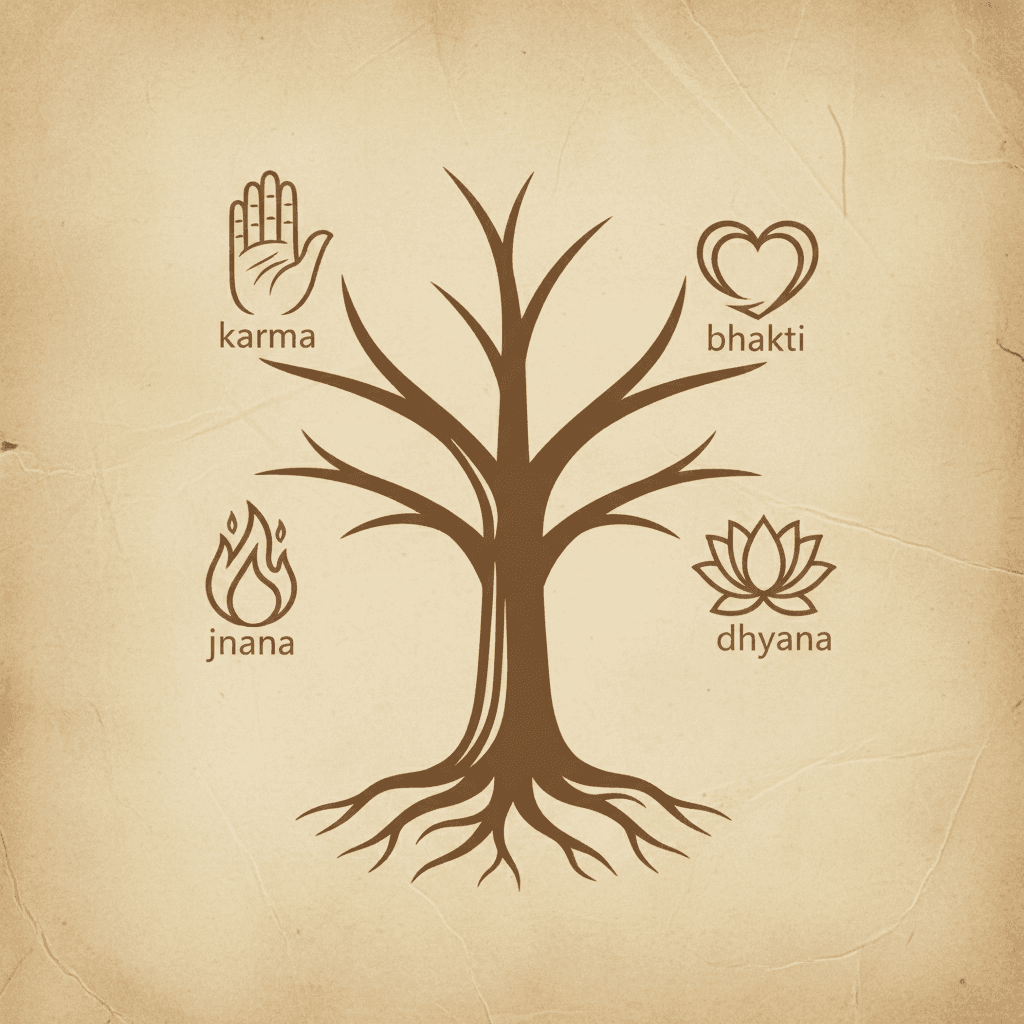
If you search "types of yoga" on Google, you'll find lists like: Hatha, Vinyasa, Ashtanga, Yin, Kundalini, Power Yoga, Hot Yoga... These are styles of āsana (posture) practice. They are variations within a single branch of yoga.
The real types of yoga -- as tradition presents them -- are complete life paths, each with its own logic, practices, and purpose. And all converge toward the same destination: [liberation (mokṣa)](/blog/moksha-o-que-e-liberacao-vedanta).
The four classical yogas
The [Bhagavad Gītā](/blog/bhagavad-gita-guia-completo) presents four main paths. They are not mutually exclusive options -- most people practice a combination -- but each has a distinct emphasis.
### 1. Karma-yoga -- the yoga of action
For whom? For everyone. It is the most universal and most necessary yoga.
[Karma-yoga](/blog/karma-yoga-acao-sem-apego) is not a type of action -- it is an attitude with which you act. The principle is:
- Do what is right (dharma)
- Give your best
- Offer the result to Īśvara
- Accept what comes as prasāda (grace)
In practice, this transforms all of life into a field of growth. Every action -- working, cooking, conversing, raising children -- becomes an opportunity for maturation. The karma-yogī doesn't need a retreat or cave. Their ashram is daily life.
Result: Purification of the mind (citta-śuddhi). The mind becomes sāttvic -- clear, calm, ready for knowledge.
### 2. Bhakti-yoga -- the yoga of devotion
For whom? For those with emotional, devotional, relational temperament.
Bhakti-yoga is the transformation of human love (with dependence and expectation) into mature love (with surrender and freedom). The bhakta relates to [Īśvara](/blog/ishvara-conceito-de-deus-vedanta) -- the Lord, the intelligence governing the cosmos -- in a personal and intimate way.
Forms of bhakti include:
- Pūjā -- ritual worship
- Kīrtana/bhajana -- devotional singing
- Sevā -- service to the guru, temple, others
- Smaraṇa -- constant remembrance of Īśvara
- Prārthanā -- prayer with surrender
Bhakti is not religious sentimentalism. It is an attitude of recognition: there exists an intelligent order greater than myself, and my relationship with it is one of respect, gratitude, and surrender.
Result: Emotional purification. The ego becomes permeable -- less rigid, less defensive, more open to knowledge.
### 3. Jñāna-yoga -- the yoga of knowledge
For whom? For those with maturity (viveka and vairāgya), interest in self-knowledge, and capacity for investigation.
Jñāna-yoga is the [study of Vedānta](/blog/como-estudar-vedanta-iniciante) under the guidance of a [qualified guru](/blog/por-que-precisamos-de-guru-vedanta). It is the direct path to mokṣa, because mokṣa is knowledge -- the recognition that you are ātman, not limited by the body-mind.
The process includes:
- Śravaṇa -- listening to the teaching (from the guru, not books alone)
- Manana -- reflection to resolve doubts
- Nididhyāsana -- deep assimilation, meditation on what was understood
Jñāna-yoga doesn't work without the preparation of karma-yoga and bhakti-yoga. An agitated, impure, or arrogant mind cannot receive the teaching. That's why the [Gītā](/blog/bhagavad-gita-guia-completo) presents karma and bhakti before jñāna.
Result: Mokṣa -- the definitive understanding that you are Brahman.
### 4. Dhyāna-yoga (Rāja-yoga) -- the yoga of meditation
For whom? For those with capacity for concentration and contemplative inclination.
Rāja-yoga, systematized by Patañjali in the Yoga Sūtras, is the path of eight stages (aṣṭāṅga-yoga).
Note that āsana is one of eight stages -- and in the Yoga Sūtras receives exactly three verses. The modern obsession with postures is a proportion inversion.
Result: A prepared mind for knowledge. Samādhi purifies and stabilizes the mind -- but, according to Vedānta, it is not mokṣa in itself.
Haṭha-yoga: the yoga of the subtle body
Haṭha-yoga is not a fifth path -- it is a set of practices that can serve any of the paths above. Focused on body (āsana), breath (prāṇāyāma), purifications (kriyā), and energy seals (mudrā), haṭha-yoga prepares the body-mind for more subtle practices.
These texts make clear that haṭha-yoga is means, not end. The Haṭhayogapradīpikā begins by saying that haṭha exists to serve rāja-yoga (deep meditation).
Modern styles: where do they fit?
The "styles" found in studios -- Vinyasa, Ashtanga (Pattabhi Jois), Iyengar, Yin, Power -- are all variations of haṭha-yoga, with different emphases.
None of them is wrong. But it's honest to recognize: if you only practice āsana, you're practicing a fraction of one branch of yoga. It's good for the body, calms the mind -- but it's not the complete yoga that tradition describes.
Which yoga is for me?
The honest answer: all of them, in different proportions.
Karma-yoga is for everyone, always. It's the basic attitude. Bhakti-yoga is for all who recognize something greater than themselves. Jñāna-yoga is for when the mind is mature -- and it will happen eventually. Dhyāna/rāja-yoga is complementary to all. Haṭha-yoga is a support tool.
Don't choose with your head -- observe your inclination. If you're more emotional, bhakti will be natural. If more analytical, jñāna will attract you. If more active, karma-yoga makes immediate sense. And over time, the paths integrate -- because the destination is the same.
Real yoga is not what you do on the mat. It's how you live when you step off it.
Want to study Vedanta in depth?
Join a Study Group →