
Vedānta and Stoicism agree that freedom is interior, not exterior -- but they fundamentally disagree about who the subject of that freedom is.
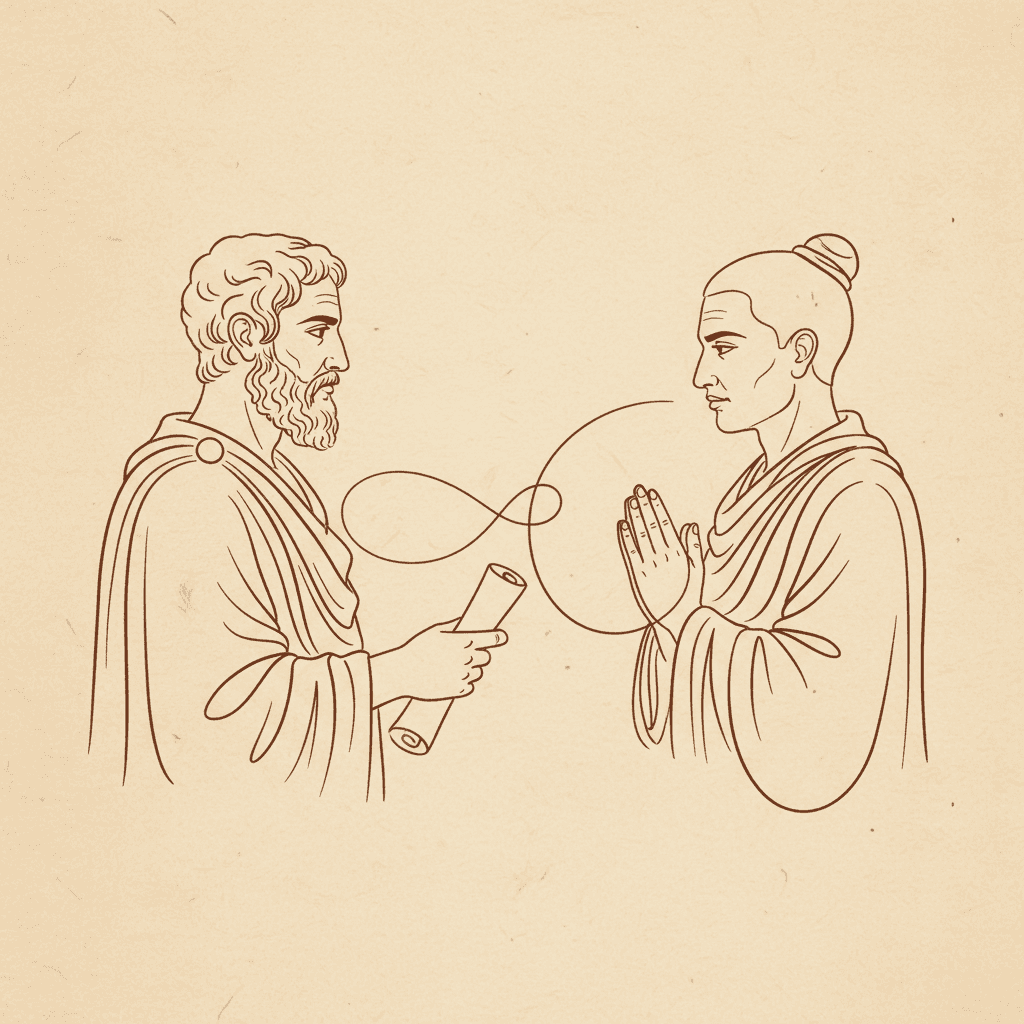
In recent years, Stoicism has come back with full force. Books on Marcus Aurelius, Seneca, and Epictetus dominate bestseller lists. And many people who arrive at Vedānta come with this Stoic background -- which raises a natural question: are they the same thing? Where do they meet? Where do they part?
Let's look carefully, because the answer isn't simple.
The meeting point: inner freedom
Both Vedānta and Stoicism teach that the source of suffering is not in external events, but in the relationship you have with them. Epictetus said: "It is not things that disturb us, but our judgments about things." The Bhagavad Gītā says something structurally similar when Kṛṣṇa teaches Arjuna about [karma-yoga](/blog/karma-yoga-acao-sem-apego) -- acting without dependence on the result.
Both systems value viveka (discernment, in Vedāntic vocabulary) or the ability to distinguish what is under our control from what is not (in Stoic vocabulary). Both teach that reacting emotionally to what you can't control is the recipe for suffering.
There's also a shared emphasis on ethics as foundation. The Stoic cultivates virtue because it's the only thing that depends on him. The Vedānta student cultivates [dharma](/blog/dharma-o-que-e-como-descobrir) because it aligns life with the cosmic order (Īśvara-sṛṣṭi) and prepares the mind for knowledge.
The fundamental divergence: who am I?
This is where the paths split decisively.
For Stoicism, you are a rational agent within the cosmos. A finite, mortal being, part of nature. Stoic freedom is the freedom of an individual who learns to relate well to the world. You remain a separate individual -- just a virtuous, resilient one, aligned with nature.
For Vedānta, you are not the individual. The individual -- with body, mind, emotions, stories -- is an appearance (mithyā). The reality of the individual is [Brahman](/blog/brahman-realidade-absoluta-vedanta), limitless existence-consciousness-fullness. Vedāntic freedom is not the freedom of an individual who functions better. It is the recognition that you were never limited.
This difference seems subtle, but it changes everything.
The Stoic works to accept death. The Vedānta student discovers that [ātman](/blog/atman-o-ser-verdadeiro-vedanta) -- the real self -- is never born and never dies. It's not acceptance. It's knowledge.
The Stoic works to not depend on the external. The Vedānta student discovers that the external is himself -- that there is no real separation between subject and object, between self and world.
Cosmology: impersonal nature vs. Īśvara
Stoicism sees the universe as rational matter -- a cosmos governed by logos, an impersonal intelligence. There is no separate creator. Nature follows its laws and the wise person aligns with them.
Vedānta presents [Īśvara](/blog/ishvara-conceito-de-deus-vedanta) -- the intelligent totality. Not a personal god who lives in heaven. Īśvara is Brahman associated with [māyā](/blog/maya-o-que-e-ilusao-vedanta), the power that manifests the universe. The order of the cosmos (dharma) is not accidental -- it is the expression of this intelligence.
In practice, this means the Stoic submits to the "nature of things." The Vedānta student recognizes an intelligence that sustains everything -- and this intelligence is not separate from who you are.
Emotions: control vs. resolution
Stoicism proposes emotional control. The passions (pathé) are disturbances to be mastered by reason. The Stoic sage feels, but doesn't get carried away.
Vedānta proposes something different: resolution through understanding. When you understand that [suffering comes from ignorance](/blog/por-que-sofremos-vedanta) about yourself -- not from lack of emotional control -- the disturbing emotions lose their root. You don't need to control the fear of death if you know you don't die. You don't need to control neediness if you discover you are [fullness](/blog/ananda).
Stoic emotional control is constant work. Vedāntic knowledge is definitive -- once you see, there's no way to "unsee."
Practice and path
The Stoic practices daily exercises: journaling, negative visualization, meditation on death. These are useful practices and many are compatible with Vedāntic preparation.
The Vedāntic path has a more defined structure: [sādhana-catuṣṭaya](/blog/5-qualidades-estudante-vedanta) (student qualifications), study with a [guru](/blog/por-que-precisamos-de-guru-vedanta), śravaṇa, manana, nididhyāsana. It's not self-help -- it's a means of knowledge (pramāṇa) that operates methodically.
That said, a person who has practiced Stoicism for years arrives at Vedānta with a more prepared mind. The emotional discipline, the habit of self-observation, the commitment to truth -- all of this is fertile ground for Vedāntic self-knowledge.
So, are they complementary?
In part, yes. Stoicism is an excellent preparation. It develops emotional maturity, discipline, and a healthier relationship with the world.
But Vedānta goes further. It's not content with a better-adapted individual. It reveals that the individual is an appearance, and that reality is [sat-cit-ānanda](/blog/o-que-e-vedanta) -- without limits, without birth, without death.
If Stoicism helped you stop suffering unnecessarily, great. Vedānta shows you that the "you" who was suffering never existed as a separate entity -- and that the freedom you were seeking is already your nature.
Want to study Vedanta in depth?
Join a Study Group →