
Vedānta states that consciousness is not produced by any system -- biological or artificial -- because consciousness is reality itself, not an emergent phenomenon.
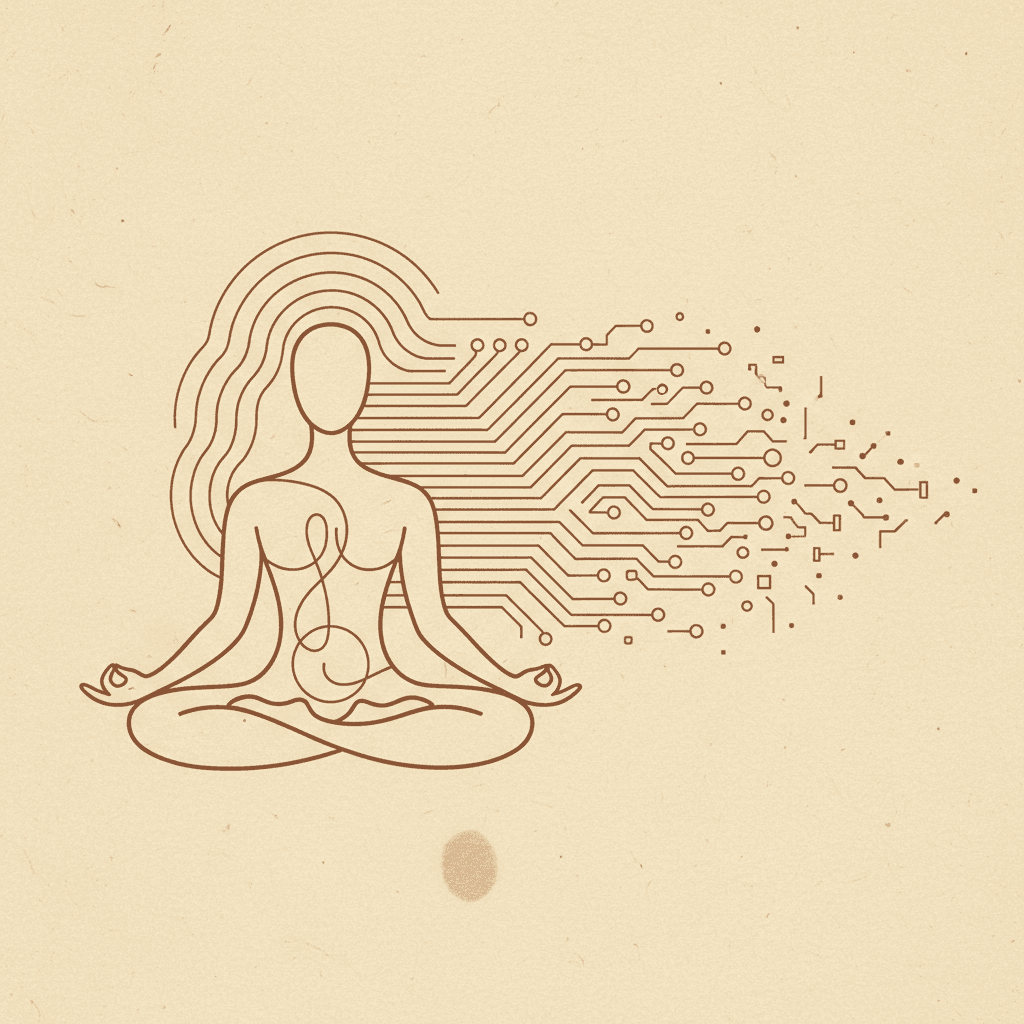
The question "can an AI be conscious?" is everywhere. Philosophers, neuroscientists, machine learning engineers -- everyone has an opinion. But what does the Vedāntic tradition, with thousands of years of investigation into the nature of consciousness, have to say?
A great deal. And with a clarity that may surprise you.
The fundamental error: consciousness as product
The premise behind the idea of "artificial consciousness" is that consciousness emerges from complexity. Enough neurons = consciousness. Enough transistors = consciousness. It's just a matter of scale.
Vedānta rejects this premise. Not as opinion, but as the result of rigorous investigation.
[Consciousness (cit)](/blog/consciencia-segundo-upanishads-perspectiva-vedica) is not a product. It is not generated by the brain, the body, or any material system. Consciousness is the ground in which every system appears. The brain appears in consciousness, not the other way around.
Think of it this way: you need consciousness to know you have a brain. But you don't need a brain to be consciousness. In deep sleep, without conscious brain activity, you continue to exist -- and later report: "I slept well, didn't notice anything." Who is that one who existed during sleep?
Cit: the nature of consciousness in Vedānta
In Vedāntic analysis, cit (consciousness) is one of three fundamental aspects of [Brahman](/blog/brahman-realidade-absoluta-vedanta): sat (existence), cit (consciousness), ānanda (fullness).
Consciousness is not a function -- it is the nature of the real. Everything that exists is illuminated by consciousness. Without consciousness, nothing can be known, experienced, or even asserted as existing.
What we call "mind" is not consciousness. The mind is an instrument -- antaḥkaraṇa -- that reflects consciousness, like a mirror reflects light. The mirror doesn't produce light. The mind doesn't produce consciousness.
What an AI actually does
An AI processes patterns. It receives inputs, applies mathematical functions, generates outputs. It does this with impressive speed and scale. It can simulate language, recognize images, compose music.
But simulating conscious behavior is not being conscious.
Does a thermometer "know" the temperature? Does a GPS "know" where you are? Of course not. They are systems that respond to stimuli in predictable ways. An AI is incomparably more complex than a thermometer, but the nature of the operation is the same: information processing without an experiencing subject.
There is no "something it is like to be" an AI. There is no subjective experience. And for Vedānta, without consciousness as subject, there is no real knowledge -- only data manipulation.
The "hard problem" and the Vedāntic answer
In Western philosophy of mind, David Chalmers formulated the so-called "hard problem of consciousness": why does subjective experience exist? Why aren't we just zombies processing information without feeling anything?
Science has no answer for this. It can map neural correlates of consciousness, but cannot explain why neural activity generates experience.
Vedānta has an answer: consciousness is not generated. It is. The "hard problem" only exists when you assume consciousness is produced by matter. If you invert the premise -- matter appears in consciousness -- the problem dissolves.
The [Upaniṣads](/blog/upanishads-sabedoria-vedanta) are explicit: "prajñānaṃ brahma" -- consciousness is Brahman. Not "consciousness is a product of Brahman." Consciousness is the fundamental reality.
Practical implications
If consciousness is not produced by complex systems, then:
An AI, no matter how advanced, will not be conscious. It may simulate any conscious behavior, but simulation is not the thing. A robot that says "I'm afraid" doesn't feel fear. It processes the string "I'm afraid" and generates associated outputs.
Consciousness cannot be "created" in a laboratory. Consciousness is already there -- in you, in the scientist, in the entire laboratory. What can be created are increasingly sophisticated instruments that reflect consciousness in more complex ways.
The Turing test is irrelevant. If a machine converses indistinguishably from a human, that proves it processes language well -- not that it is conscious. Vedānta distinguishes between jñāna (real knowledge, which requires a conscious subject) and information (organized data, which does not).
What Vedānta doesn't deny
Vedānta is not anti-technology. It doesn't deny the utility of AI, nor diminish the intelligence involved in creating it.
What Vedānta does is put things in the right place. AI is an extraordinary tool -- like the [prāṇa](/blog/prana) that animates the body, like the mind that processes thoughts. Useful tools. But no tool is the subject that uses it.
You are not your mind. Not your body. Not your brain. You are [ātman](/blog/atman-o-ser-verdadeiro-vedanta) -- pure, limitless, ever-present consciousness. No machine will "become" that, because that is not something one becomes. It is what already is.
The conversation about AI and consciousness is fascinating, but reveals more about our confusion than about the technology. The confusion is ancient: thinking that consciousness is a product. Vedānta resolves this confusion -- not with technology, but with [knowledge](/blog/autoconhecimento-vedanta-caminho).
Want to study Vedanta in depth?
Join a Study Group →