
Vedānta and psychoanalysis converge in investigating the ego as a problem, but diverge on what lies beyond it -- for Freud, more unconscious; for Vedānta, pure consciousness.
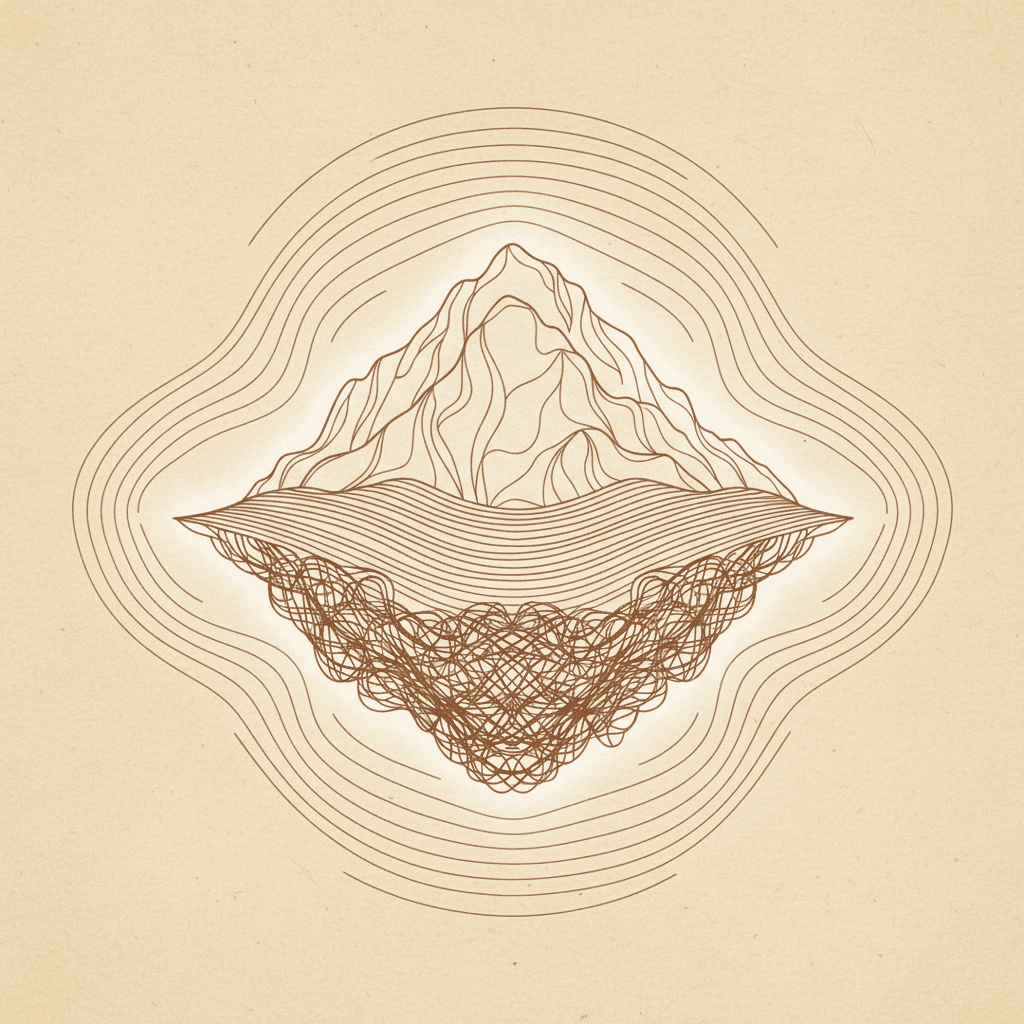
The comparison between Vedānta and psychoanalysis comes up frequently -- and it makes sense. Both deal with suffering. Both investigate the mind. Both question the narrative of the "I" we assume in daily life. But the surface similarities hide deep differences worth exploring.
The ego in Freud
For Freud, the ego (Ich/das Ich) is the mediating agency between the id (impulses), the superego (internalized norms), and external reality. The ego isn't "bad" -- it's necessary. Without a functional ego, the person can't operate in the world.
The problem arises when the ego uses defense mechanisms (repression, projection, rationalization) that distort perception of reality. Therapy seeks to strengthen the ego -- making it more flexible, conscious, capable of handling internal conflicts without excessive distortion.
For psychoanalysis, the goal is a healthy ego.
The ego in Vedānta
In Vedānta, the [ego](/blog/ego) (ahaṃkāra) is something quite specific: it is the principle of individuation -- the thought "I am so-and-so." It is not a mediating agency. It is the identification of consciousness with the body-mind.
Ahaṃkāra is what makes the limitless appear limited. It is the fundamental confusion: taking the instrument (body, mind) for the subject (ātman, consciousness).
Vedānta's goal is not to strengthen the ego. It is to see through it. To recognize that the ego is functional (mithyā -- dependently real), useful for operating in the world, but not who you are.
This is the first major divergence: psychoanalysis wants a better ego. Vedānta wants you to discover that you are not the ego.
The unconscious: comparison
Freud revolutionized by proposing that most of mental life is unconscious. Desires, memories, traumas -- they operate below consciousness and determine behavior.
Jung went further, proposing a collective unconscious with archetypes shared by humanity.
Vedānta recognizes something analogous: the kāraṇa-śarīra (causal body), which contains the vāsanās (latent tendencies) and saṃskāras (impressions) accumulated over time. These tendencies operate below conscious perception and condition thoughts, emotions, and reactions.
The similarity is real. But the difference is fundamental.
For psychoanalysis, the unconscious is mental content -- repressed desires, forgotten memories, complexes. Making unconscious conscious is therapeutic.
For Vedānta, the vāsanās are subtle matter (part of prakṛti). They are content of the mind, not of the self. The self -- [ātman](/blog/atman-o-ser-verdadeiro-vedanta) -- is pure consciousness, which illuminates both the conscious and unconscious without being affected by either.
It's like the difference between cleaning the mirror and realizing that you are not the mirror.
The nature of suffering
For psychoanalysis, suffering comes from internal conflicts -- between desire and prohibition, between impulse and reality, between parts of the psyche in disagreement.
For Vedānta, suffering comes from avidyā (fundamental ignorance) -- the confusion about who you are. It's not conflict between parts of the ego. It's the fact that you, who are [limitless](/blog/ananda), take yourself to be limited.
The internal conflicts that psychoanalysis treats are real and relevant. Vedānta doesn't deny this. But it situates these conflicts within a larger problem: all of them belong to the ego -- and the ego is not you.
[Resolving suffering](/blog/por-que-sofremos-vedanta) in Vedānta is not about reorganizing mental contents. It is about recognizing that you are beyond all contents.
Method: interpretation vs. knowledge
Psychoanalysis operates through interpretation. The analyst listens, observes patterns, offers interpretations that allow the patient to see what was hidden. It's a relational, gradual process that can last years.
Vedānta operates through direct knowledge (jñāna). The guru teaches using śāstra (revealed texts) as a means of knowledge. It's not interpretation -- it's revelation of the nature of the real through a precise method ([śravaṇa, manana, nididhyāsana](/blog/o-que-e-vedanta)).
In psychoanalysis, the process is interminable by nature -- there is always more unconscious to explore. In Vedānta, knowledge is definitive. Once you see that you are not the ego, there's no way to "unsee."
Can they complement each other?
At a certain level, yes.
Psychoanalysis (or psychotherapy in general) can be extremely useful as preparation for Vedānta study. If the mind is too disturbed by traumas, severe conflicts, or pathologies, Vedāntic study is compromised. The mind needs a minimum of stability to [receive knowledge](/blog/5-qualidades-estudante-vedanta).
Vedānta also recognizes the importance of emotional maturity. [Karma-yoga](/blog/karma-yoga-acao-sem-apego) and [universal values](/blog/dharma-o-que-e-como-descobrir) are, in part, practices that do what therapy does by other means: reduce reactivity, increase self-observation, create internal space.
But the complementarity has limits. Psychoanalysis cannot do what Vedānta does -- reveal the nature of the self. And Vedānta doesn't propose to do what psychoanalysis does -- treat specific mental pathologies.
The difference that changes everything
[Psychology](/blog/vedanta-e-psicologia-diferenca) (in all its branches) operates within the paradigm: you are an individual and we will help this individual function better.
Vedānta operates in another paradigm: you are not the individual. The individual is an appearance. You are the limitless consciousness in which the individual appears.
It's not that one paradigm is right and the other wrong. They serve different purposes. If you want to function better as an individual, therapy is excellent. If you want to discover who you are beyond the individual, Vedānta is the path.
And if you've done enough therapy to have a relatively stable ego, the question Vedānta asks becomes the most relevant of your life: now that the ego is functioning, who are you beyond it?
This question is not answered on the analyst's couch. It is answered in study with a [qualified teacher](/blog/por-que-precisamos-de-guru-vedanta) who has the tools to reveal what no analysis of the unconscious can reach: [the self that was never unconscious](/blog/quem-sou-eu-vedanta-resposta).
Want to study Vedanta in depth?
Join a Study Group →