
Āśram and gurukulam are words many people use interchangeably. And in practice, they often refer to the same place. But there's a subtle difference – and understanding this difference helps you know what to expect when you're looking for a place to study.
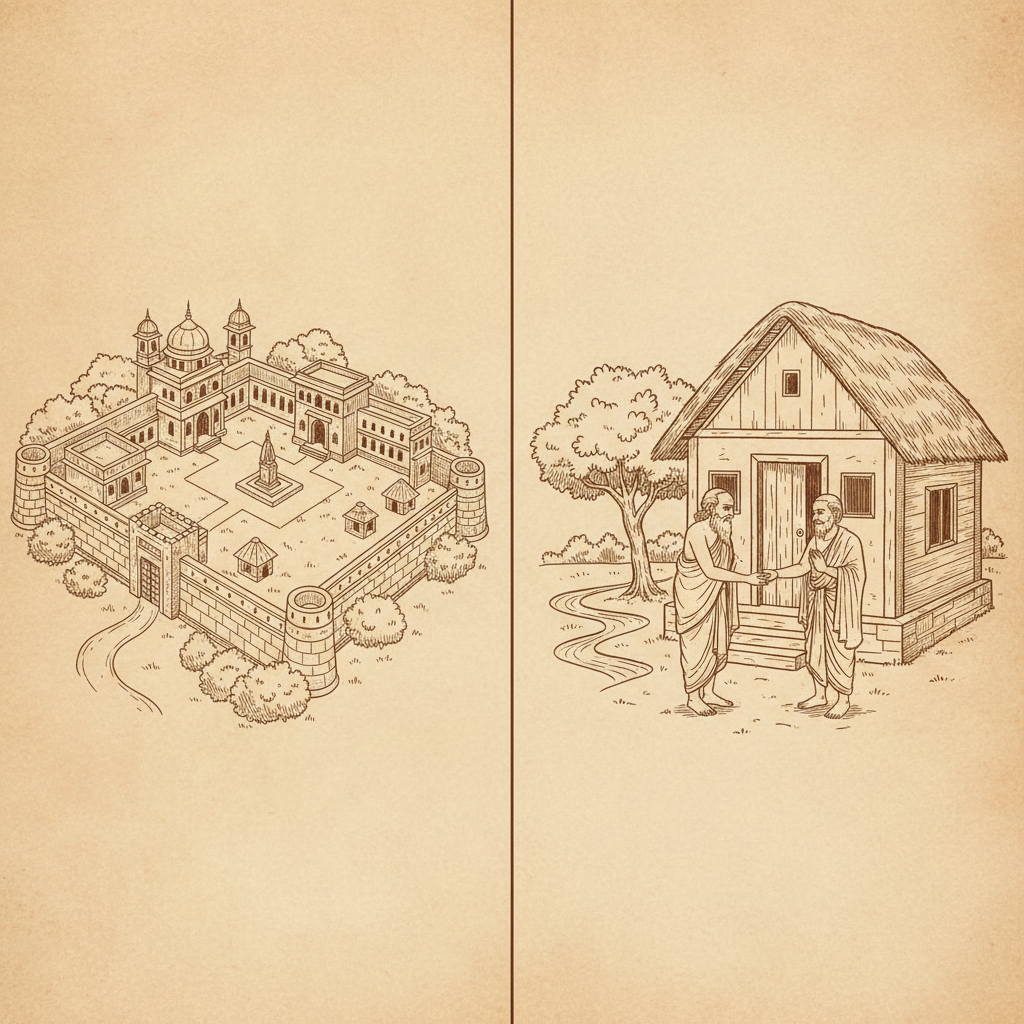
The short answer: an āśram is a place for spiritual practice; a gurukulam is a place where you live and study with a teacher. If the teacher lives in the āśram, the two are the same thing. If not, they are different.
Now let's break it down.
Āśram: Etymology and Meaning
The word āśram comes from the Sanskrit root *śram*, which means "effort" or "discipline." The prefix *ā* indicates direction. Āśram is, literally, a place where effort is made – spiritual effort.
In practice, āśram refers to a place of retreat and spiritual practice. The expectation is of a larger space – a property, a farm, something with room to accommodate people living there for longer periods.
Think of a monastery. The analogy isn't perfect, but it captures the essence: a place where people who share a spiritual lifestyle live together, follow a routine, and practice together.
Characteristics of an āśram: - Ample physical space – generally a rural or semi-rural property - Community living – people live there, not just visit - Structured routine – schedules for practices, study, meals, service - Open to visitors – many āśrams welcome people for short periods - Not necessarily a school – there can be practices, rituals, and community living without formal teaching
This last point is crucial. An āśram without a resident teacher is essentially a retreat center. It can be beautiful, organized, have an impeccable spiritual routine – but if there's no guru teaching, it's not a gurukulam.
Gurukulam: The Teacher's Home
The word gurukulam is composed of two parts: - Guru – teacher - Kula – family, home, lineage
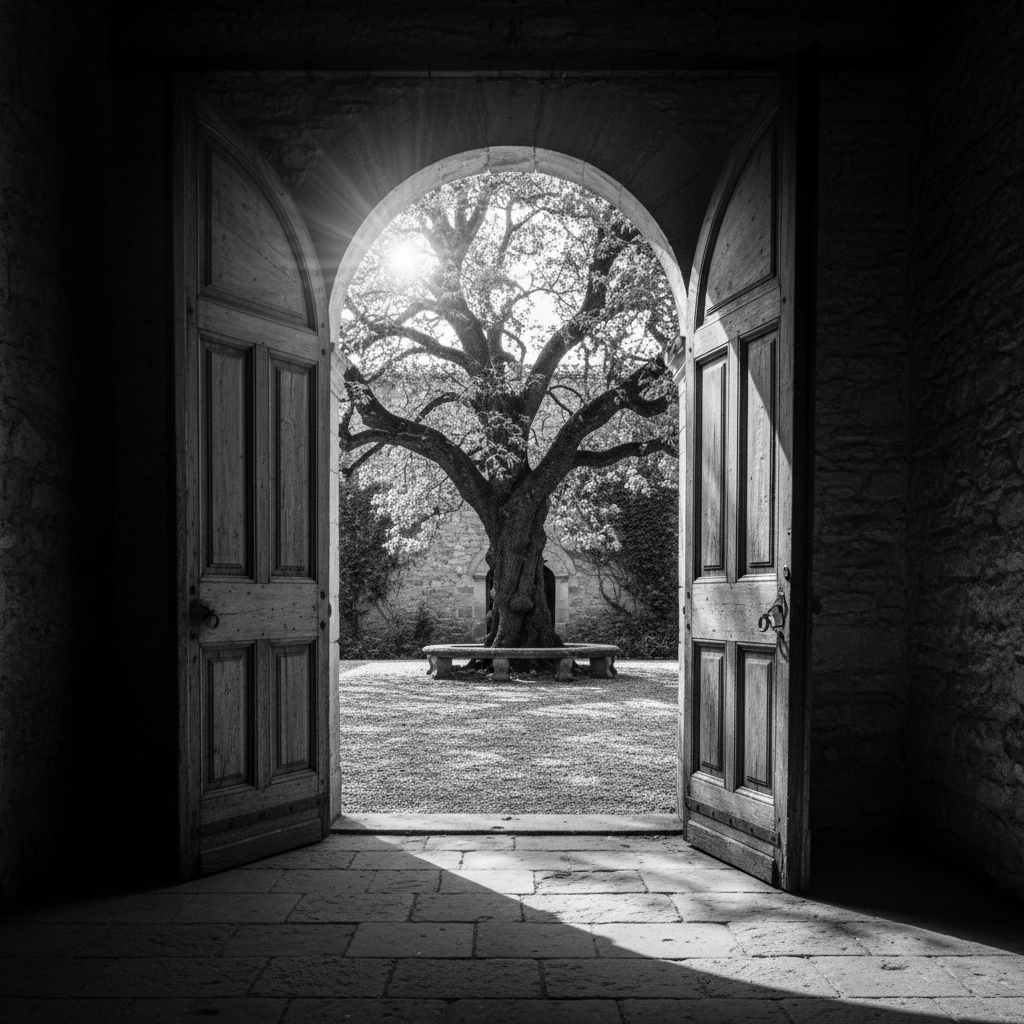
Gurukulam is, literally, the teacher's home – or, more precisely, the teacher's family. It's the place where students live with the teacher, as part of their family.
This is radically different from a school in the modern sense. There are no "classes" at fixed times with a rigid curriculum (though there might be). Learning happens as part of life. You live with the teacher, observe how they live, ask questions when they arise, study when it's time to study, serve when it's time to serve.
In the ancient Vedic tradition, a young person would go to live in the teacher's gurukulam for years – sometimes 12 years or more. There, they would learn the Vedas, dharma, and eventually Vedānta. Learning was organic, integrated into daily life.
Characteristics of a gurukulam: - Presence of a resident guru – this is the defining element - Study as part of life – not just in a classroom - Learning community – students live and learn together - Personal relationship with the teacher – it's not mass teaching - Not necessarily formal – may not have a "curriculum" in the modern sense
The Difference in Practice
So, in practice, what's the difference?
Āśram without a resident guru = retreat center with a spiritual routine. You can go, practice, meditate, live in community. But there's no systematic teaching. It's a place for practice, not study.
Āśram with a resident guru = āśram AND gurukulam at the same time. Most well-known āśrams in India function this way – there's a main teacher who lives there and teaches. In this case, the words are practically interchangeable.
Gurukulam without āśram structure = it could be the teacher's own home, or a smaller space where students gather to study and live together. It doesn't need to be a huge farm. What defines it is the presence of the guru and the shared life of study.
Why This Matters
If you're looking for where to study Vedānta, this distinction is practical:
- If you want to study seriously, look for a gurukulam – a place where there is a qualified teacher teaching. The physical structure matters less than the presence of the guru.
2. If you want a period of retreat and practice, an āśram can serve even without a resident guru. For meditation, karma-yoga, and community living, the āśram environment already has value.
3. If you want the complete experience, look for an āśram that functions as a gurukulam – where there is a teacher, study, practice, and community living. This is what events like Vedanta Camp offer in a concentrated format.
Gurukulam Is Not a School
This is a point that deserves emphasis. When most people hear "gurukulam," they think of school. But the word kula (family, home) already indicates something different.
In a school, you go, attend class, and go home. In a gurukulam, you live there. The distinction between "class time" and "non-class time" dissolves. The teacher isn't someone you see for 50 minutes and then forget – they are someone whose life you observe, whose values you absorb, whose presence transforms.
The deepest learning doesn't happen in formal class. It happens in the shared meal, the walk after dinner, the question asked at the right moment, the silent example of how the teacher handles a difficult situation.
This model of learning – living with the teacher – is what the Vedic tradition considers ideal. It's not the only path (online study, courses, retreats – all have value), but it is the most complete.
The Vishva Vidya Gurukulam
A modern example is the Vishva Vidya Gurukulam, in Petropolis (RJ). It's a space where the tradition of teaching Vedānta is kept alive – with study of classical texts, practices, community living, and the presence of a teacher.
It's not a replica of the ancient Indian gurukulam. It's an adaptation for the contemporary Brazilian context. But the essential elements are there: guru, study, coexistence, practice.
Practical Summary
| | Āśram | Gurukulam | |---|---|---| | Meaning | Place of spiritual effort | Teacher's home/family | | Central element | Space and routine | Teacher's presence | | Analogy | Monastery | Family of study | | Without a guru | Retreat center | Doesn't exist without a guru | | With a guru | = Gurukulam | = Āśram (if the space accommodates) |
When in doubt: if there's a guru teaching, it's a gurukulam. If there's space and a spiritual routine, it's an āśram. If it has both, use whichever word you prefer – you'll be right either way.
Want to study Vedanta in depth?
Join a Study Group →