
The cakras are subtle body energy centers described in the texts of Haṭha Yoga and Tantra — and almost everything the internet says about them is a simplification or invention.
If you've seen those images of colorful discs aligned over the body, with rainbow colors and corresponding crystals — know that none of this comes from the original texts. It's a Western creation from the 20th century, vaguely inspired by the tradition, but disconnected from it.
Let's get to what the texts actually say.
The word cakra
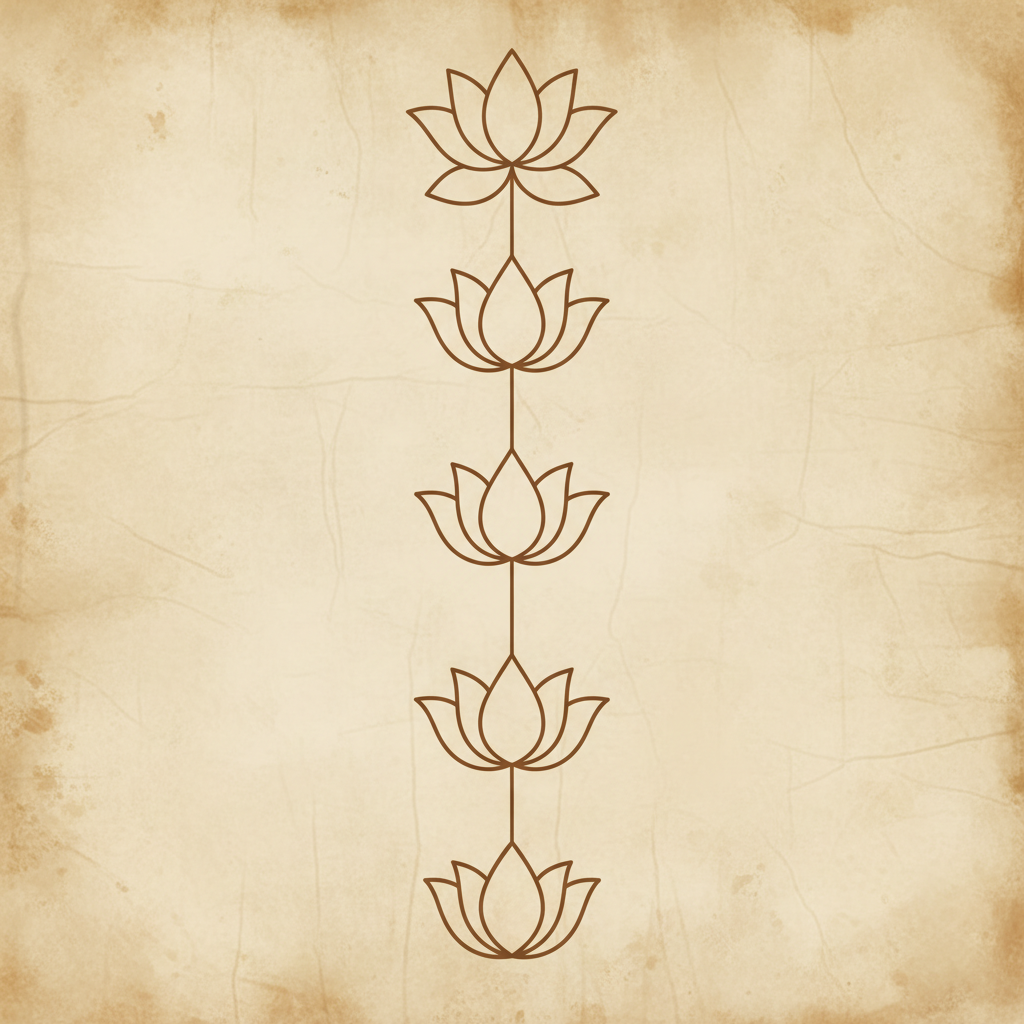
Cakra (चक्र) in Sanskrit means "wheel" or "circle." In the context of yoga, it refers to convergence points of energy (prāṇa) in the subtle body (sūkṣma śarīra). They are described as lotuses (padma) with different numbers of petals, each petal associated with a letter of the Sanskrit alphabet.
The cakras are not anatomical structures. They are not "in the body" in the sense that medicine understands. They are in the subtle body — the level of experience that includes mind, vital energy, and cognitive functions.
The seven main chakras
The reference text is the Ṣaṭcakranirūpaṇa (Description of the Six Centers), attributed to Pūrṇānanda Svāmī (16th century). It describes six cakras along the suṣumnā nāḍī (central channel), plus the sahasrāra at the top.
1. Mūlādhāra — base of the spine
- Petals: 4 (letters: va, śa, ṣa, sa)
- Element: earth (pṛthivī)
- Bīja mantra: laṃ
- Associated with stability, survival, foundation. Here resides the dormant kuṇḍalinī.
2. Svādhiṣṭhāna — pelvic region
- Petals: 6
- Element: water (ap)
- Bīja mantra: vaṃ
- Associated with creativity, fluidity, procreation.
3. Maṇipūra — navel region
- Petals: 10
- Element: fire (agni/tejas)
- Bīja mantra: raṃ
- Associated with digestion (physical and subtle), will, power of transformation.
4. Anāhata — heart region
- Petals: 12
- Element: air (vāyu)
- Bīja mantra: yaṃ
- Associated with the un-struck sound (anāhata nāda), devotion, compassion.
5. Viśuddha — throat
- Petals: 16
- Element: space (ākāśa)
- Bīja mantra: haṃ
- Associated with expression, purification, true communication.
6. Ājñā — between the eyebrows
- Petals: 2
- Element: beyond the five elements
- Bīja mantra: oṃ
- Associated with command (ājñā), intuition, inner guru.
7. Sahasrāra — crown of the head
- Petals: 1,000 (or infinite)
- Not considered a cakra strictly speaking, but the point of dissolution. Where kuṇḍalinī meets Śiva — pure consciousness.
What the texts DON'T say
Let's be direct about what is modern invention:
Rainbow colors. The texts describe colors — but not like a rainbow. Each cakra has specific colors associated with the petals and the resident deity, but they do not correspond to the ROYGBIV system popularized in the West.
Corresponding crystals. This has no textual basis. It's a creation of the New Age movement of the 1970s-80s.
"Opening" or "unblocking" chakras. The texts speak of awakening (prabodhana) and making kuṇḍalinī ascend — not of "opening" or "unblocking." The metaphor is of lotuses blooming as energy rises, not of locked doors.
Chakras as emotional diagnosis. "Your third chakra is blocked because you have self-esteem issues." This is popular psychology mixed with Indian terminology. The texts describe the cakras in terms of elements, mantras, deities, and energetic functions — not as a map of emotional problems.
Chakras and the five elements
A genuine and profound aspect of the cakras is their relationship with the pañca mahābhūtāni (five great elements):
- Earth → Mūlādhāra (solidity, structure)
- Water → Svādhiṣṭhāna (fluidity, adaptation)
- Fire → Maṇipūra (transformation, digestion)
- Air → Anāhata (movement, expansion)
- Space → Viśuddha (openness, vastness)
This correspondence reflects the understanding that the microcosm (body) mirrors the macrocosm (universe). The same elements that compose creation compose the human being — and the cakras are the points where this correspondence manifests in the subtle body.
To understand how Vedānta sees the relationship between microcosm and macrocosm, see Ātman and Brahman: what's the difference?.
Chakras and meditation
In traditional practices, the cakras are used as supports for meditation (dhyāna). The practitioner visualizes the lotus, the resident deity, the bīja mantra, and concentrates the mind on that point. This develops concentration and sensitivity to the subtle body.
These practices are part of upāsanā — meditative practices that prepare the mind for self-knowledge. They are not self-knowledge itself.
The Vedānta perspective
Vedānta recognizes the validity of the chakra system as a description of the subtle body, but does not depend on it for its central teaching.
The point of Vedānta is: you are not the subtle body. You are not the cakras. You are not kuṇḍalinī. You are ātman — pure consciousness, which illuminates the subtle body just as it illuminates the physical one.
Knowing the cakras is useful. Identifying with the cakras is another layer of ignorance.
Practical advice
If you want to study chakras seriously:
- Read the original texts (with translation and commentary). The Ṣaṭcakranirūpaṇa with commentary by Arthur Avalon (Sir John Woodroffe) is a good start, despite being old.
- Be wary of simplifications. If someone promises to "align your chakras" in a session, they are selling something the texts do not describe.
- Practice with guidance. Meditations on the chakras are advanced practices. Start with the basics — āsana, prāṇāyāma, simple meditation — and progress with guidance from a teacher.
- Maintain perspective. Chakras are a map, not the territory. The territory is you — consciousness, the witness of all, not limited to any energy center.
The chakras are fascinating. And, like everything fascinating in the tradition, the risk is getting lost in the fascination and forgetting the purpose: to discover who is fascinated.
Want to study Vedanta in depth?
Join a Study Group →