
In most yoga studios, nobody mentions Vedānta. And in most Vedānta studies, Hatha Yoga receives little attention. They seem like two separate worlds.
But if you open the Haṭha Yoga Pradīpikā — the most important classical text of Hatha Yoga — you will find something that contradicts this separation right in the first chapter.
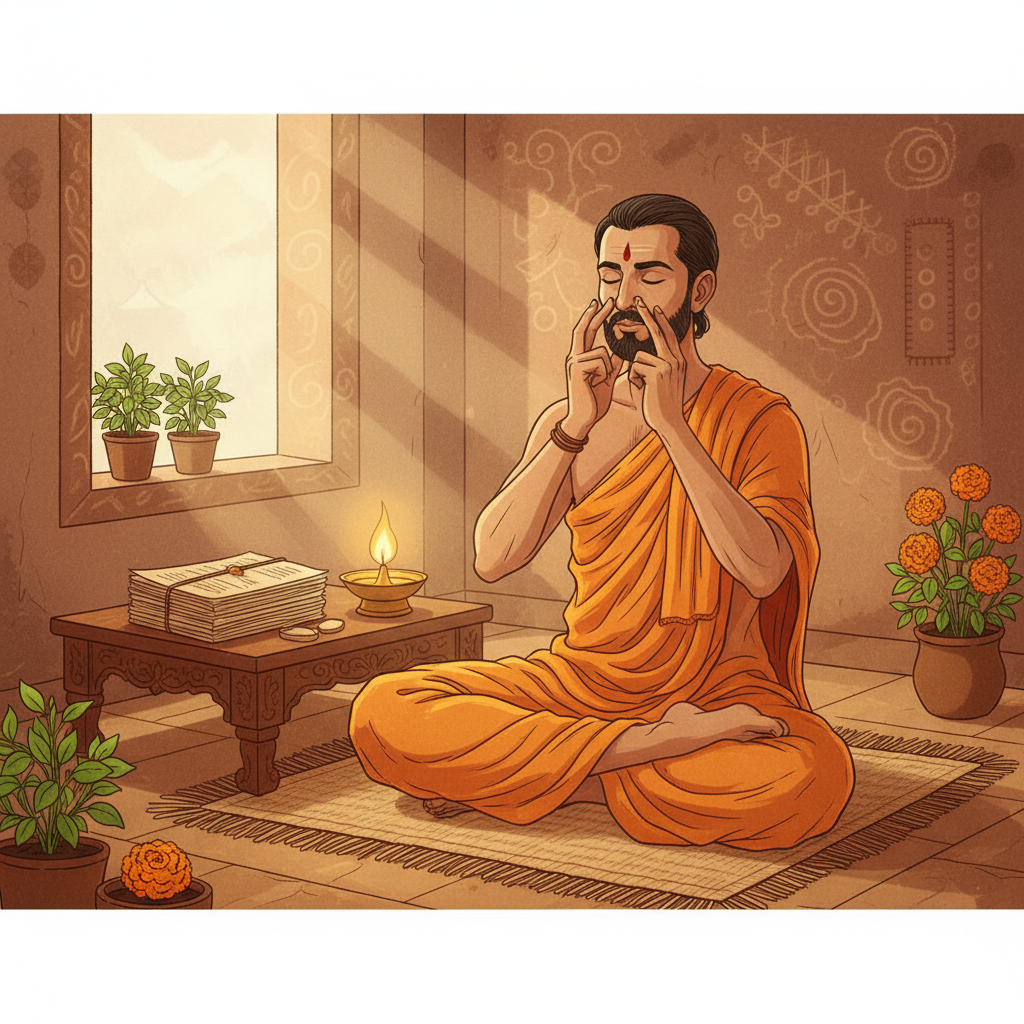
What the Haṭha Yoga Pradīpikā says
Svātmārāma, the author of the text, is explicit:
"Haṭha-yoga is offered as a staircase for those who wish to reach the heights of rāja-yoga."
And at the end of the text (chapter 4), in describing the state of samādhi, he uses language any Vedānta student would recognize: the dissolution of duality between observer and observed, the recognition of consciousness as non-dual.
The Haṭha Yoga Pradīpikā is not a Vedānta text. But its ultimate goal is compatible with — and points toward — what Vedānta teaches.
The problem: yoga without philosophy, philosophy without the body
Over the centuries, especially in the West, two things happened:
Yoga lost its philosophy. The practices of āsana and prāṇāyāma were extracted from the spiritual context and packaged as fitness. The modern practitioner does postures without knowing why — beyond "I feel good."
Vedānta lost the body. In many schools of Vedānta, especially in the more intellectual Advaita tradition, the body is treated as irrelevant. "You are not the body" became an excuse to ignore the body. But Śaṅkara himself said the body is necessary as an instrument (sādhana).
These two extremes — body without knowledge, knowledge without the body — are both incomplete.
The integrated vision
The complete Vedic tradition includes both. Here is how they connect:
Karma-yoga: purification of the mind
Before anything else, the mind needs a certain maturity. Karma-yoga — the attitude of offering actions to Īśvara and receiving results as prasāda — is what creates that maturity. This develops in daily life, not on the yoga mat.
Hatha Yoga: preparation of the instrument
A body that is sick, rigid, or full of energetic imbalances makes meditation and study difficult. Hatha Yoga — āsana, prāṇāyāma, ṣaṭkarma — prepares the body and balances the prāṇa. A stable body and balanced breath create ideal conditions for śravaṇa (listening to the teaching).
Upāsana/Dhyāna: focusing the mind
Meditation (dhyāna) and contemplative practices (upāsana) develop the concentration capacity (ekāgratā) needed to receive the teaching.
Vedānta: the knowledge
With a prepared mind, the student is ready for śravaṇa, manana, and nididhyāsana — the Vedāntic method that removes ignorance about one's own nature.
See the logic: Hatha Yoga is not the destination — it is part of the vehicle.

Prāṇāyāma: the bridge between body and mind
If there is one practice that directly connects Hatha Yoga and Vedānta, it is prāṇāyāma.
Prāṇa (vital energy) is what connects the gross body to the subtle body. When prāṇa is agitated, the mind is agitated. When prāṇa is balanced, the mind naturally becomes focused.
The Hatha Yoga texts describe prāṇāyāma as the practice that "purifies the nāḍīs" — the energy channels of the subtle body. Vedānta describes the mind as made of five prāṇas (prāṇa, apāna, vyāna, udāna, samāna). Controlling prāṇa is therefore controlling the mind.
It is no coincidence that Patañjali in the Yoga Sūtras (which, while not a Hatha Yoga text, belong to the same broad tradition) says prāṇāyāma makes the mind "fit for concentration" (dhāraṇāsu ca yogyatā manasaḥ).
What Vedānta says about the body
Vedānta does not reject the body. It analyzes the body with precision:
- Sthūla-śarīra (gross body) — made of the five elements, born and dies
- Sūkṣma-śarīra (subtle body) — prāṇa, mind (manas), intellect (buddhi), memory (citta), ego (ahaṅkāra)
- Kāraṇa-śarīra (causal body) — fundamental ignorance (avidyā)
Vedānta teaches that you are none of these three bodies. But as long as there is identification with them, they need to be cared for and understood. Ignoring the body is not wisdom — it is denial.
The integrated practice: how it works day to day
For a Vedānta student who also practices Hatha Yoga, the routine might include:
In the morning: - Prāṇāyāma (nāḍī śodhana, 10-15 minutes) - Āsana (short sequence focused on stability, 20-30 minutes) - Meditation/contemplation (15-20 minutes)
Throughout the day: - Karma-yoga — attitude of offering in all actions - Study — listening to a class, reading a text, reflection
Before sleep: - Short prāṇāyāma (5 minutes) - Review of the day (sandhyā-vandana or equivalent)
This routine is neither mandatory nor unique. It is an example of how the pieces fit together when yoga and Vedānta are seen as parts of the same path.
The Vishva Vidya tradition and this integration
At Vishva Vidya, we work with exactly this integrated vision. Vedānta is the heart of the teaching — the knowledge that liberates. But yoga, prāṇāyāma, and meditation are the instruments that prepare the ground.
We do not see Hatha Yoga as something separate from Vedānta, nor Vedānta as something that ignores the body. They are parts of a coherent whole — as they always were.
To understand more about Hatha Yoga itself, start with What is Hatha Yoga — the original meaning. To see how classical yoga differs from modern yoga, read Hatha Yoga vs Modern Yoga.
Want to study Vedanta in depth?
Join a Study Group →