
Let me be direct: the yoga most people practice today did not exist 100 years ago. That does not mean it is bad. It means it is different — very different — from what the classical texts described as Hatha Yoga.
Understanding this difference is not an academic exercise. It is what allows you to make informed choices about your practice.
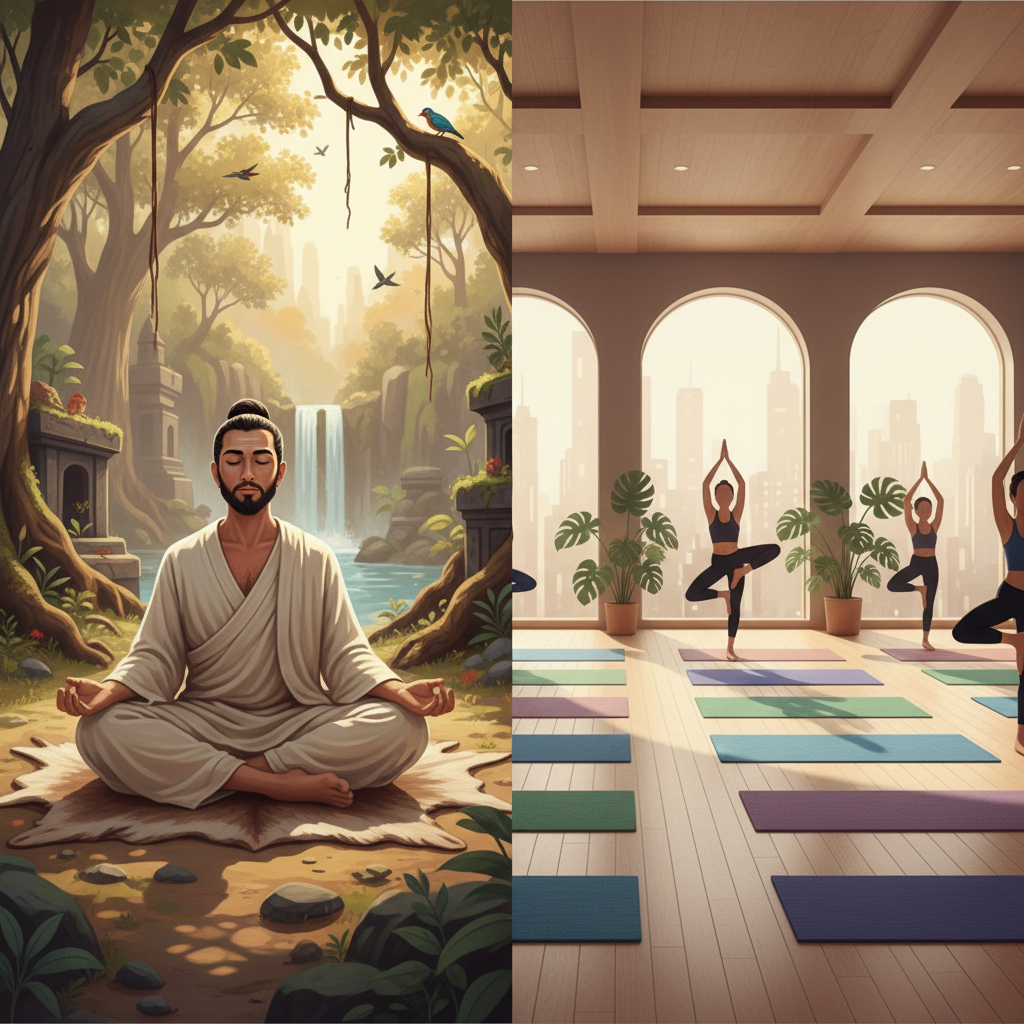
The yoga of 1,000 years ago
The classical Hatha Yoga texts — Haṭha Yoga Pradīpikā, Gheraṇḍa Saṃhitā, Śiva Saṃhitā — describe a system with clear components:
- Ṣaṭkarma — body purification
- Āsana — postures (few, held for extended periods)
- Prāṇāyāma — breath control (the central practice)
- Mudrā — energetic seals
- Bandha — body locks
- Pratyāhāra/Dhāraṇā/Dhyāna — interiorization and meditation
The declared objective: preparing body and mind for samādhi — and, according to Vedānta, for self-knowledge (ātma-jñāna).
Today's yoga
Contemporary yoga — the kind you find in gyms, apps, and retreats — is centered on āsana. A typical class consists of posture sequences with fluid transitions, sometimes with music, sometimes with artificial heat.
The most common modalities — Vinyasa, Power Yoga, Ashtanga (by Pattabhi Jois), Iyengar — all come from the school of T. Krishnamacharya, who in the early 20th century reorganized and expanded the āsana repertoire, incorporating elements of European gymnastics and Indian military exercises.
This is historically documented. Researcher Mark Singleton showed in the book "Yoga Body" how many "classical" postures actually date from the 20th century.
What changed: 5 concrete differences
1. From prāṇāyāma to āsana
In classical Hatha Yoga, prāṇāyāma is the central practice. Āsana exists to prepare the body for sitting in prāṇāyāma and meditation. In modern yoga, āsana occupies 90% of the time. Prāṇāyāma, when it appears, gets 5 minutes at the end.
2. From few held āsanas to many āsanas in flow
The Haṭha Yoga Pradīpikā describes 15 āsanas. The Gheraṇḍa Saṃhitā, 32. All held steadily for prolonged periods. Modern yoga uses hundreds of postures in dynamic sequences. The logic shifted: from stability to movement.
3. From individual practice to group class
Hatha Yoga was transmitted individually, from guru to śiṣya (student). The teacher observed the student, prescribed specific practices, adjusted as needed. The group class is a modern invention — economically efficient, but unable to offer personalization.

4. From subtle body to physical body
Classical Hatha Yoga works with concepts like nāḍīs (energy channels), cakras (energy centers), kuṇḍalinī (latent energy at the base of the spine). These are not metaphors — they are technical descriptions of the subtle body. Modern yoga generally works with Western anatomy: muscles, joints, flexibility. When it mentions cakras, it is usually in a superficial or new-age manner.
5. From spiritual preparation to physical well-being
The goal of original Hatha Yoga is explicit: preparing body and mind for spiritual knowledge. The goal of modern yoga, for most practitioners, is health, flexibility, stress reduction, and well-being. Both are legitimate. But they are fundamentally different objectives.
What was lost
I do not wish to romanticize the past. Medieval yogīs lived in very different contexts from ours. Not all practices are safe or suitable for everyone.
But some losses are significant:
Advanced prāṇāyāma — kumbhaka (breath retention) with specific ratios is a transformative tool. Most modern practitioners have never experienced this.
Mudrās and bandhas — practices working directly with prāṇa and the subtle body. They have nearly disappeared from regular classes.
The philosophical context — Hatha Yoga was one of the aṅgas (limbs) of a complete spiritual path. Dissociated from that context, āsana becomes gymnastics — good, useful, but incomplete.
The guru-śiṣya relationship — personalized transmission of practices, adapted to the individual, with direct supervision. In a yoga app, this simply does not exist.
What to recover (without dropping what works)
The proposal is not to abandon modern yoga. It is to complement it with what was left out:
- Study prāṇāyāma with a qualified teacher. Start with nāḍī śodhana (alternate nostril breathing) and progress to kumbhaka.
- Read the texts — at least the Haṭha Yoga Pradīpikā. Understand the complete system.
- Ask "for what purpose?" — what is the objective of my practice? Health? Mental peace? Self-knowledge? The answer determines what you need.
- Seek context — understand that Hatha Yoga is part of a larger tradition. To learn about this connection, read Hatha Yoga and Vedānta: the original connection.
Yoga is much larger than any 60-minute class. Discovering this is, in itself, a gift. And to understand what "hatha yoga" truly means, see What is Hatha Yoga — the original meaning.
Want to study Vedanta in depth?
Join a Study Group →