
Many people chant Om without knowing exactly what they are doing. And that's okay — we all start that way. But when you understand the technique and the meaning behind each part of the sound, the practice changes completely.
I'm going to teach you how to chant Om the way the Vedic tradition teaches — and why every detail makes a difference.
First things first: what are you doing?
When you chant Om, you're not "singing a mantra." You're using sound as an instrument of contemplation. Om is the pratīka (symbol) of Brahman — the totality of reality. Chanting Om with understanding is a form of meditation (upāsana).
If you just produce the sound without knowing what it represents, the practice becomes mechanical. Functional, yes — it helps you relax. But it doesn't fulfill its complete purpose.
The step-by-step technique
1. Posture
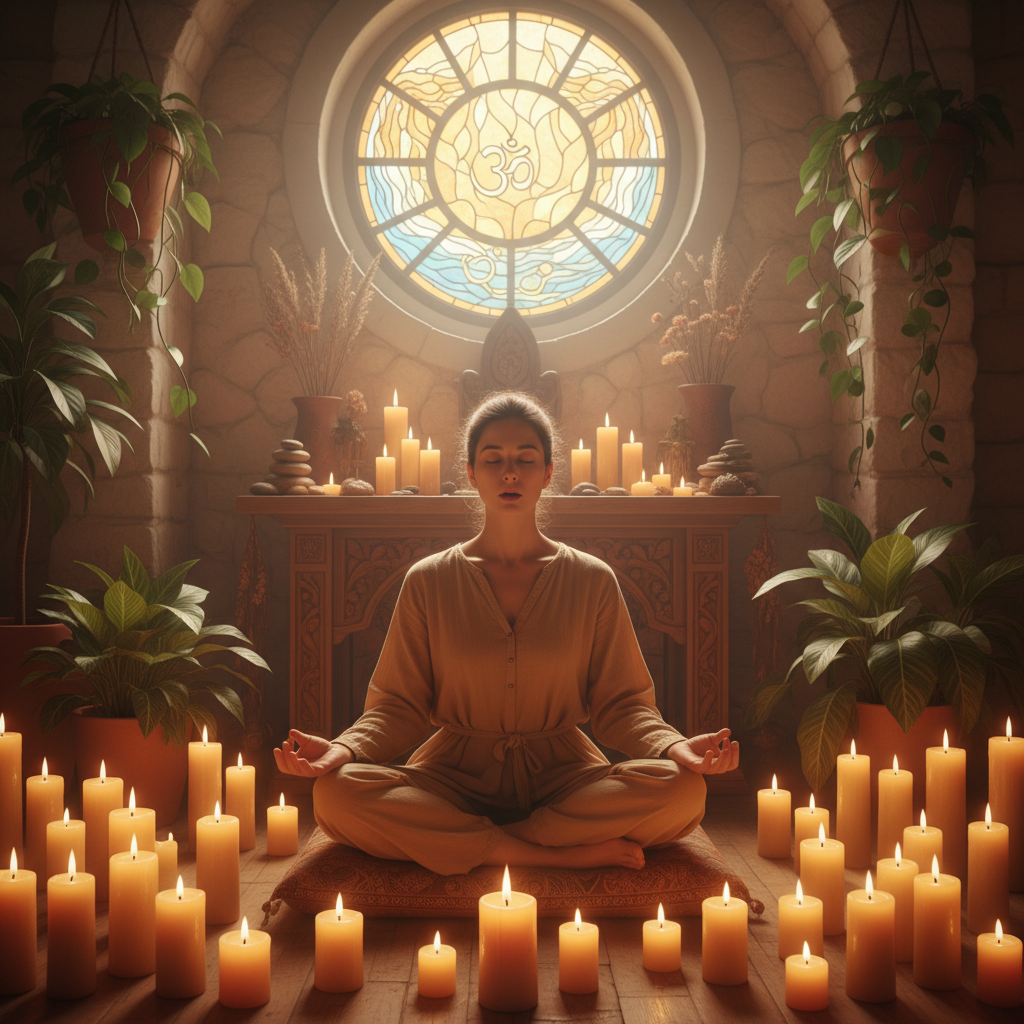
Sit firmly and comfortably (sthira-sukham). You can: - On the floor, with a cushion (zafu or similar) - In a chair, feet flat on the floor - In lotus or half-lotus position, if comfortable
Spine erect — not rigid, but elongated. Shoulders relaxed. Hands on your knees or in your lap.
2. Preparatory breathing
Before you begin, take 3 deep breaths: - Inhale through your nose, expanding your abdomen - Exhale slowly through your mouth - On the third exhale, close your eyes
3. Producing the sound
Om is divided into three parts + silence:
A (aaa...) — Open your mouth. The sound starts in the throat and resonates in the chest. Feel the vibration in your thorax. It lasts approximately 1/4 of the total time.
U (uuu...) — Without closing your mouth completely, round your lips. The sound rises to the middle region — throat and palate. It lasts approximately 1/4 of the total time.
M (mmm...) — Close your lips. The sound vibrates in the head — skull, sinuses, the top of your head. It lasts approximately 1/4 of the total time.
Silence — After the M dissipates, remain in silence. This is the fourth aspect — turīya — and it's the most important. It lasts approximately 1/4 of the total time.
4. Rhythm and duration
- Each complete Om should last between 5 and 15 seconds
- Start with 5-7 seconds and gradually lengthen it naturally
- Don't force it — the sound should flow effortlessly
- Between each Om, take a natural pause to inhale
5. Quantity
The tradition recommends odd numbers: 3, 7, 11, or 21 repetitions. For daily practice, 7 to 11 is ideal. In a study context, 3 is sufficient.
Common mistakes (and how to fix them)
Mistake 1: Nasal sound from the beginning Many people go "ooommm" directly through their nose. The A needs to start in the throat, with your mouth open.
Mistake 2: Skipping the silence The silence after the M is not a "pause between repetitions." It's an integral part of Om. It's precisely the silence that points to turīya — the consciousness that you are.
Mistake 3: Chanting too quickly Om is not meant to be rushed. The purpose is contemplation. If you're rushing, you're not contemplating.
Mistake 4: Forcing the volume too much Om doesn't need to be loud. It can be whispered or even mental (mānasa-japa). What matters is attention, not volume.

Om aloud, whispered, or mental?
The tradition recognizes three forms:
- Vaikharī (loud voice) — for beginners and for classes. The external sound helps the mind to focus.
- Upāṁśu (whispered) — lips move, but with almost no sound. More subtle.
- Mānasa (mental) — only in the mind. Considered the most powerful, but requires practice.
Start with a loud voice. When your mind is steady, transition to a whisper. Over time, mental practice becomes natural.
When to practice?
The best times are:
- Dawn (brāhma-muhūrta) — between 4 am and 6 am. The mind is naturally quiet.
- Before studying Vedānta — it prepares the mind to receive the teaching.
- Before sleeping — it helps the transition to deep sleep.
- Anytime you feel agitated — 3 Oms are enough to recenter yourself.
The complete practice: a 10-minute routine
- Sit down. Adjust your posture. (1 min)
- Three deep breaths. (1 min)
- Chant 7 complete Oms, paying attention to each part. (5 min)
- Remain in silence, observing your inner space. (3 min)
Do this daily for 21 days and notice the difference.
Meaning transforms technique
The technique is important, but the meaning is what transforms the practice. When you know that A represents the waking state, U the dream state, M the deep sleep state, and the silence is the consciousness that permeates everything — you are no longer "doing an exercise." You are contemplating reality.
And that's when Om stops being a mantra and becomes knowledge.
Want to study Vedanta in depth?
Join a Study Group →