
Life purpose isn't found—it's discovered, when the confusion about who you are begins to unravel.
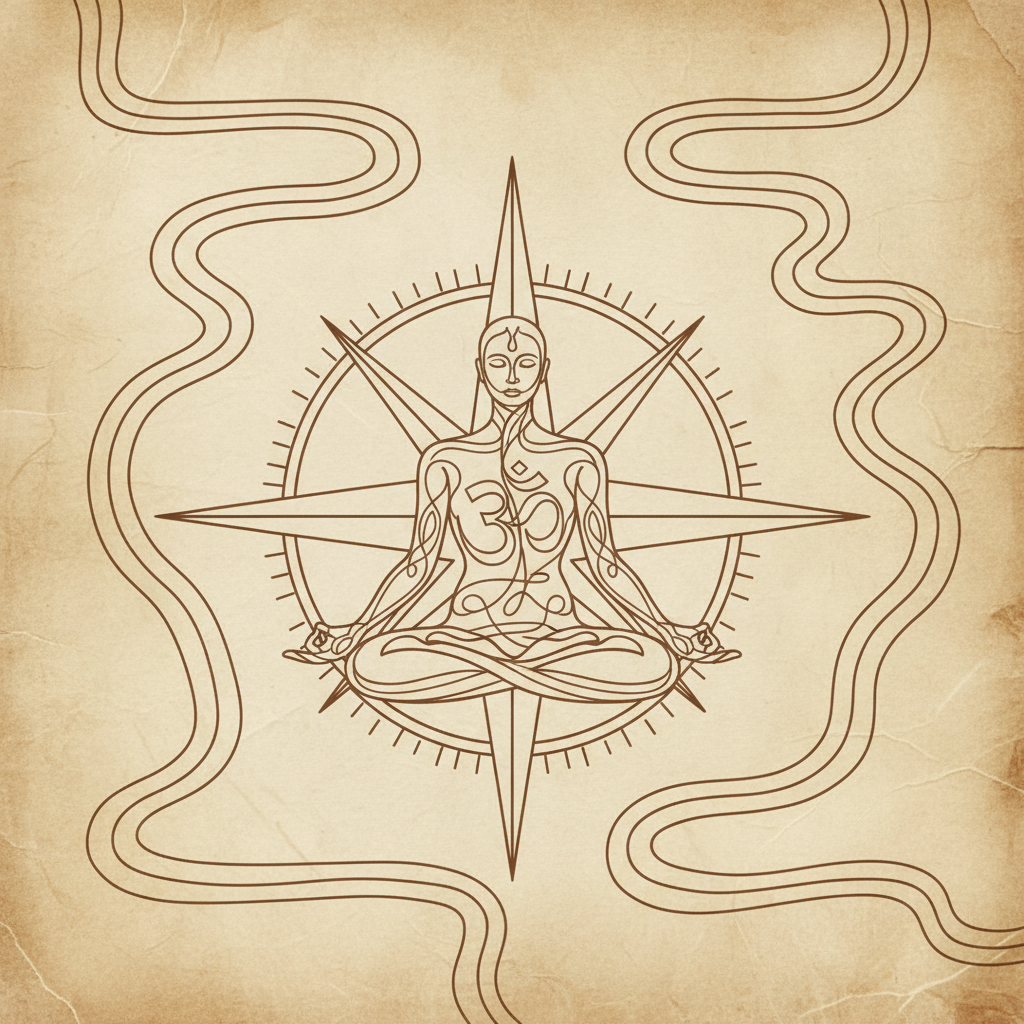
This search for purpose is one of the most universal there is. Everyone, at some point, asks themselves: "Why am I here?" The self-development industry has created a billion-dollar market around this question. Personality tests, visualization exercises, "find your calling" retreats. And yet, most people remain dissatisfied.
Why? Because we are looking in the wrong place.
The problem with "finding" purpose
When someone says "I need to find my purpose," the phrase already carries an assumption: that purpose is an object out there, waiting to be found. As if there were an envelope with your name on it somewhere in the universe, and all you had to do was open it to discover what to do.
This mindset turns the search into another source of anxiety. "What if I don't find it? What if I choose wrong? What if my purpose is something I don't like?"
The Vedānta tradition approaches this in a completely different way. It's not about finding something new—it's about removing the confusion that hides what is already present.
Dharma: the concept that precedes "purpose"
In Sanskrit, the closest word to "purpose" is dharma. But dharma is much broader than the modern idea of "life purpose." Dharma means that which sustains—the order that keeps everything functioning.
There is universal dharma (the laws that govern the cosmos) and there is your svadharma—that which is yours to do, given your situation, your abilities, your stage of life.
In the Bhagavad Gītā, Kṛṣṇa tells Arjuna:
śreyān svadharmo viguṇaḥ paradharmāt svanuṣṭhitāt
"Better is one's own dharma, though imperfectly performed, than the dharma of another well performed."
This is radical. There is no "better" purpose in absolute terms. What exists is your dharma—and it depends on who you are, not on who you wish you were.
Self-knowledge comes before purpose
Most people try to define purpose without knowing who they are. It's like trying to draw a route without knowing where you are on the map.

The self-knowledge that Vedānta speaks of is not psychological (though it includes that). It is ontological—it deals with the fundamental nature of who you are. And the discovery is that you are ātman—pure consciousness, not limited by body, mind, or circumstances.
When this understanding begins to mature, the question "what is my purpose?" changes in quality. It ceases to be a desperate search for meaning and becomes a lucid investigation into how you can contribute from what you already are.
To better understand the relationship between ātman and the search for completeness, see Ātman and Brahman: What's the Difference?.
Three common misconceptions about purpose
1. "Purpose is a profession"
Many people think that finding purpose means finding the right career. But purpose is not a job. You can live with purpose as a teacher, a carpenter, a doctor, or unemployed. What changes is the attitude with which you live—not the activity.
2. "Purpose needs to be grand"
Social media culture has led us to believe that purpose must be epic—changing the world, impacting millions, leaving a legacy. But dharma is not about grandiosity. It's about appropriateness. Sometimes, your dharma is to take care of your mother. Sometimes it's to do your work with integrity. Nothing glamorous. Everything essential.
3. "Purpose is fixed"
Svadharma changes. The dharma of a student is different from the dharma of a parent. The dharma of someone healthy is different from the dharma of someone sick. Purpose is not a destination—it is a continuous response to what life presents.
The role of karma-yoga
If purpose is not something to be found, but a way of living, then the practical tool for it is karma-yoga—the attitude of acting without attachment to the result.
Karma-yoga doesn't mean doing just anything. It means doing what is yours to do (svadharma), in the best way possible, offering the result to something greater than your personal desires.
In practice, this translates to:
Doing what needs to be done, not what is comfortable Accepting the result as it comes, without depending on it to feel good Being present in the action, without dwelling on imagined alternatives
When someone lives this way, the question "what is my purpose?" dissolves naturally. Not because the person gave up—but because their whole life has become the purpose.
How to start
If you are at the point of "I don't know what my purpose is," here is an honest path:
- Stop searching—the anxious search is part of the problem. Purpose is not found by effort; it is revealed by clarity.
2. Study who you are—not with personality tests, but with real self-knowledge. Understand the difference between what you do and what you are.
3. Observe your svadharma—what is life asking of you now? Not tomorrow, not in the ideal future. Now.
4. Practice karma-yoga—do what is yours to do, with presence and without attachment. If the action is appropriate and the attitude is mature, the "purpose" reveals itself.
5. Develop viveka—discernment between what depends on you and what does not. Between what is essential and what is noise.
The real question
Deep down, the search for purpose is a search for completeness. The person wants to feel whole, significant, relevant. And Vedānta says something that may seem radical: you are already complete. The incompleteness you feel is not real—it is the result of ignorance about yourself.
When this ignorance begins to unravel—with study, reflection, and emotional maturity—what remains is not a person without purpose, but a person who doesn't need a purpose to feel good. And, paradoxically, this is the person who contributes the most. Because they act from fullness, not from lack.
Purpose, in the end, is not something you find. It is what remains when you stop looking.
Want to study Vedanta in depth?
Join a Study Group →