
If you practice meditation with mantra, you have probably wondered: "What exactly is this for?" That is a fair question. Most instructions circulating out there are vague — "repeat and feel the energy," "let the mantra work for you," "tune into the universal vibration."
None of those instructions are wrong in the conventional sense. But in Vedānta, the relationship between mantra and meditation is far more precise — and far more useful when you understand it.
The role of mantra in Vedānta
Let us be direct: in Vedānta, mantra is not the end. It is the means.
The objective of Vedānta is ātma-jñānam — knowledge of the self. Recognizing that you are Brahman, unlimited consciousness, not limited by body, mind, or circumstances. This recognition occurs through listening to the teaching (śravaṇa) from a qualified teacher, reflection (manana), and assimilation (nididhyāsana).
Mantra operates primarily as preparation. The mind needs a certain quality to receive the Vedāntic teaching. Quality of attention, stability, the capacity to stay with a thought without being dragged by others. This is what the tradition calls citta-śuddhi (mental purification) and citta-naiścalyam (mental stability).
Japa (mantra repetition) develops both.
Upāsana: meditation as directed contemplation
In Vedic terminology, the practice with mantra is called upāsana — directed contemplation. It is not the same as nididhyāsana (assimilation of Vedāntic knowledge), though the two complement each other.
Upāsana works like this: you take an aspect of Īśvara (the totality) and contemplate it with sustained attention. The mantra is the vehicle for that contemplation.
When you recite Om Namaḥ Śivāya with understanding, you are not merely vibrating syllables. You are contemplating: "The fundamental reality is auspicious (śivam). I revere that reality." Each repetition is an act of recognition, not of request.
This is radically different from using mantra as a relaxation technique. There is nothing wrong with relaxing — but upāsana goes beyond.
The complete cycle: karma-yoga, upāsana, jñāna
The Vedic tradition describes a natural path:
- Karma-yoga — action with an attitude of offering to Īśvara and acceptance of results as prasāda. This produces emotional maturity. You stop depending on results to feel complete. Read more about karma-yoga.
2. Upāsana — meditative practice (including japa) that stabilizes and refines the mind. The agitated mind cannot assimilate subtle knowledge. Upāsana creates the necessary condition.
3. Jñāna (Vedānta) — listening, reflection, and assimilation of the teaching. This is the direct means of liberation (mokṣa).
Mantra sits in the second stage. It is a bridge, not a destination. But without that bridge, the third stage becomes much more difficult.

Practice: how to use mantra according to Vedānta
Here is a protocol based on the tradition:
Before sitting
- Clear intention: "I am practicing to refine my mind and prepare myself for knowledge." This is not a positive affirmation — it is direction.
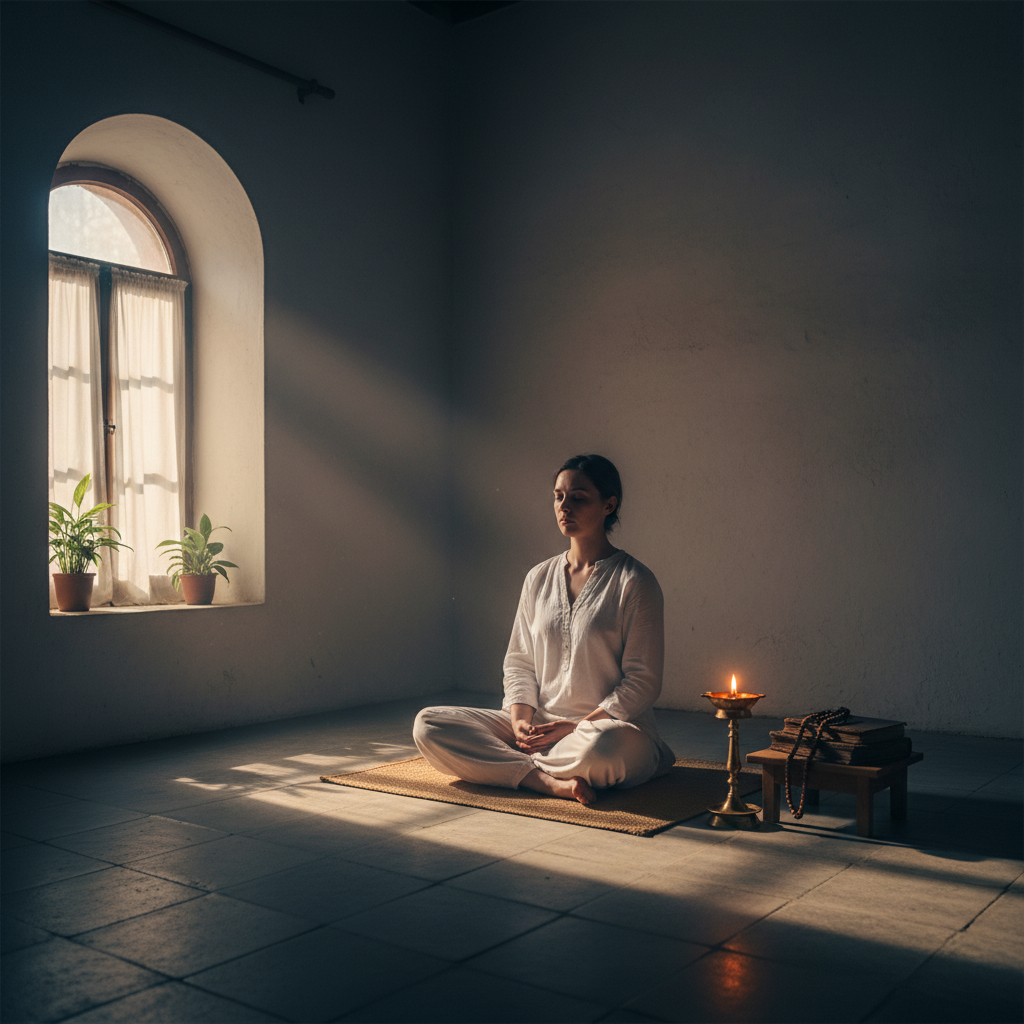
- Environment: clean, quiet, distraction-free. The tradition recommends a fixed space (āsana-siddhi — "mastering the seat"). Same place, same time, every day.
During practice
- Invocation: begin with a short prayer. The śānti-pāṭha works well: "Om sahana vavatu, sahanau bhunaktu..." This establishes the sacred context.
2. Japa: repeat the chosen mantra with a mālā. See our guide on mantras for meditation to choose. - First rounds aloud (vaikharī) - Then, whispered (upāṃśu) - Finally, mental (mānasa) - The progression from outside to inside is natural and need not be forced
3. Contemplation: after completing the japa, release the mālā. Sit in silence. This moment after japa is precious — the mind is quieted and receptive. Do not fill it with anything. Simply be.
4. Closing: end with three Om and a dedication: "Om sarve bhavantu sukhinaḥ" — "May all beings be happy."
After practice
- Do not evaluate. "Was it a good meditation?" is a question that hinders. Every practice done with attention is good practice.
- Record if you wish — not the experience, but the regularity. "I practiced 15 minutes" is more useful than "I felt peace."
The three most common obstacles
1. Expectation of experience
"When will I feel something?" Perhaps never, in the sense you expect. Mental refinement is subtle. You do not feel the mind becoming more stable — you notice, months later, that you react differently to situations. It is cumulative and silent.
2. Irregularity
Three days of intense practice followed by two weeks of nothing. This does not work. Ten daily minutes surpass any sporadic marathon. The mind needs pattern, not intensity.
3. Confusing means with end
Japa is a tool. If you do 10 mālās a day but never study Vedānta, you are using the tool without knowing what it is for. Mantra prepares the ground. Vedānta plants the seed.
When the mantra becomes unnecessary
This may surprise you: in the Vedic tradition, there comes a point where formal japa practice naturally decreases. When the mind is already stable and Vedāntic knowledge is being assimilated, the need for an anchor diminishes.
This does not mean abandoning the mantra. Many masters maintained japa practice throughout their lives — as an expression of gratitude and devotion, not as a necessity. The relationship with the mantra changes: from tool to celebration.
Practical conclusion
If you want to use mantra intelligently within the path of Vedānta:
- Choose a mantra and keep it for at least 6 months. Do not switch every week.
- Practice every day, even if only 10 minutes.
- Understand the meaning of what you recite. Read about the most important Sanskrit mantras.
- Study Vedānta in parallel. Mantra without study is preparation without direction.
- Be patient. Profound results take time. There is no shortcut.
Mantra is not magic. It is discipline with direction. And when the direction is self-knowledge, there is no more honest tool.
Want to study Vedanta in depth?
Join a Study Group →