
You have probably heard the sound Om. Perhaps in a yoga class, a meditation app, or a YouTube video with relaxing music. But what does this sound really mean?
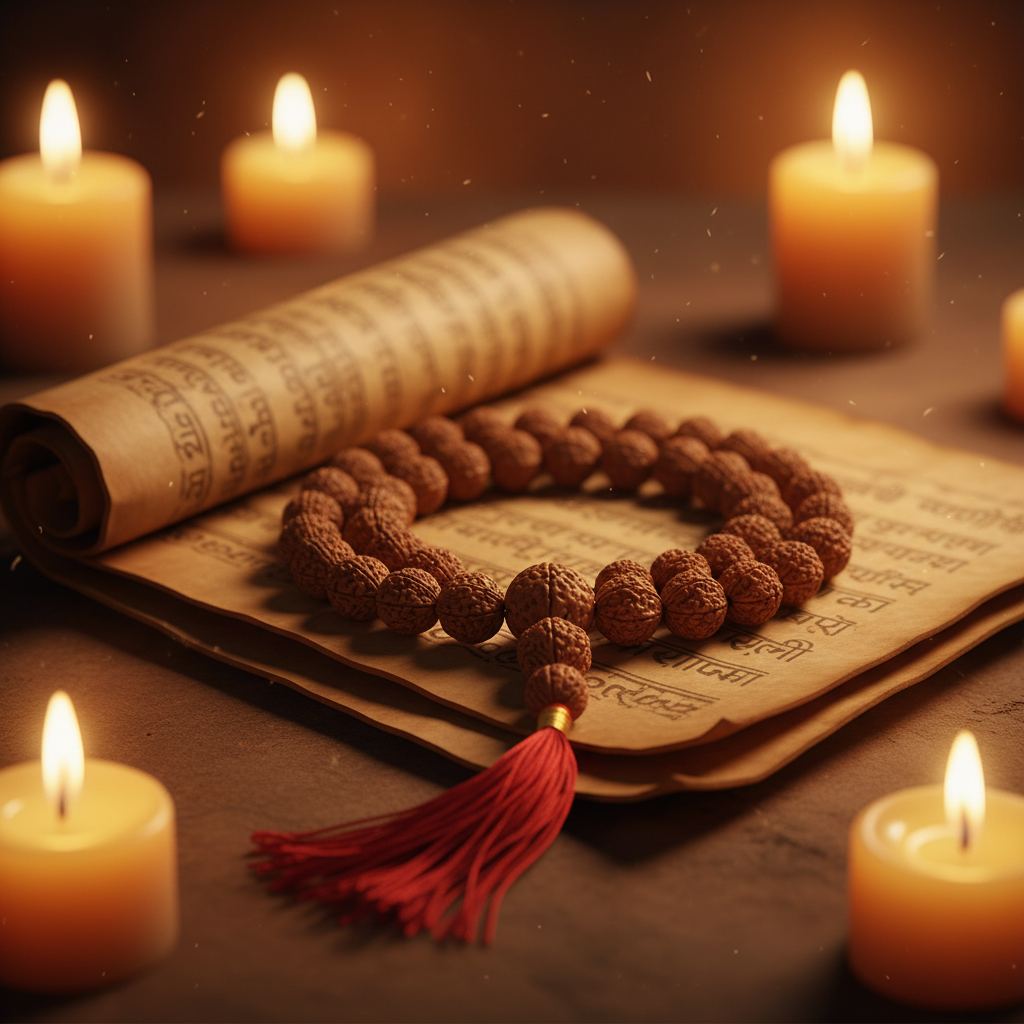
In the Vedic tradition, Om is not sonic decoration. It is considered the most fundamental mantra that exists — the sound representing the totality (Brahman). That is not an exaggeration. It is what the texts say, and it makes sense once you understand why.
The structure of Om: three sounds, one reality
Om is composed of three phonemes: A + U + M. In Sanskrit, when A and U combine, they form O. So A-U-M is pronounced Om. Each phoneme represents something:
- A — the waking state (jāgrat). The world you perceive while awake. It is the most open sound the human throat produces.
- U — the dream state (svapna). The internal, subjective world created by the mind.
- M — the deep sleep state (suṣupti). Absence of duality, total repose.
And the silence after the M? That is the fourth — turīya — the consciousness that pervades and witnesses the three states. It is not an additional state. It is you yourself, the consciousness in which the three states appear and disappear.
The Māṇḍūkya Upaniṣad dedicates its 12 verses entirely to this analysis. It is one of the densest and most profound texts in all Vedic literature.
Om as the name of Īśvara
In the Bhagavad Gītā (7.8), Kṛṣṇa says: "praṇavaḥ sarva-vedeṣu" — "I am the praṇava (Om) in all the Vedas." Om is not just a sound. It is the sonic name of Īśvara — the intelligent totality.
When you chant Om, you are not invoking an external deity. You are recognizing the totality that includes you, the world, and everything that exists. It is contemplation, not blind devotion.
Patañjali, in the Yoga Sūtra (1.27-28), says that Om is the designator of Īśvara (tasya vācakaḥ praṇavaḥ) and that its repetition with contemplation of the meaning (taj-japas tad-artha-bhāvanam) leads to self-knowledge.
Notice: it is not mechanical repetition. It is repetition with understanding.
Why Om appears at the beginning of everything
If you have ever attended a pūjā (Vedic ritual), you know that almost every mantra begins with Om. Why?

Because Om establishes the context. By starting any sacred action with Om, you are saying: "What I do now is offered to the totality." It is Īśvara-arpaṇa-buddhi — the attitude of karma-yoga — expressed in sound.
It also appears at the beginning of texts (Om iti). It is a marker of auspiciousness (maṅgala) and a reminder that the knowledge which follows points to the same totality.
How to practice Om correctly
Here is a practical guide, without unnecessary mysticism:
Posture: - Sit with spine erect, shoulders relaxed - On the floor (cushion) or in a chair - Hands on knees or in cin-mudrā (thumb and index finger together)
The pronunciation: 1. Inhale deeply through the nose 2. While exhaling, produce the sound AAAA (mouth open, sound from the abdomen) 3. Transition smoothly to UUUU (lips round) 4. Close with MMMM (lips closed, vibration in the skull) 5. Remain in the silence — this is the most important moment
The traditional proportion is: A (1 beat) + U (1 beat) + M (1 beat) + silence (at least 1 beat).
Duration: - Start with 5 minutes (approximately 10-15 repetitions) - Gradually increase to 15-20 minutes - 108 repetitions is the complete traditional practice
When to practice: - Dawn (brahma-muhūrta, before sunrise) is ideal - Before meditating, as preparation - Before studying Vedic texts, to quiet the mind
Common mistakes
- Mechanical repetition — without attention to meaning, Om becomes mere vibration. It works for relaxation, but not for contemplation.
- Forcing the volume — Om does not need to be loud. It can be whispered or mental (mānasa japa). The subtler is generally the more powerful.
- Seeking experiences — "I saw lights," "I felt energy." Experiences come and go. The purpose of Om is knowledge, not experience.
Om and Vedānta
If you study Vedānta, Om is your constant companion. Not because it is obligatory, but because it is the sound that summarizes everything Vedānta teaches: you are the totality, and nothing is separate from you.
The Chāndogya Upaniṣad opens with: "Om ity etad akṣaram udgītham upāsīta" — "One should meditate upon the syllable Om as the udgītha (principal chant)." It is not a suggestion. It is a direct instruction from the most ancient texts we have.
Om in daily life
You do not need to be sitting in formal meditation to benefit from Om. The tradition suggests reciting it before any significant activity: before studying, before eating, before an important conversation. Not as a superstitious ritual, but as a reminder. Om reconnects you with the totality before the mind fragments into parts.
Many people recite Om mentally in traffic, in a waiting line, before sleep. There are no rigid rules. The criterion is simple: if it brings attention and quietude, it is working.
Explore more about Sanskrit mantras and how to use mantra in meditation according to Vedānta.
Want to study Vedanta in depth?
Join a Study Group →