
You want to start meditating with mantras but do not know which to choose. You have reason to be confused — the internet is full of lists mixing "powerful mantras to attract abundance" with millennia-old Vedic mantras, as if they were the same thing.
They are not. Let us separate tradition from modern invention, and give you a practical guide based on what actually works.
First: what is mantra meditation?
Meditation with mantra (japa dhyāna) is the practice of repeating a mantra with sustained attention. It is not relaxation, not creative visualization, not hypnosis. It is attention training with a defined direction.
The mind, by nature, is scattered. It goes from thought to thought without stopping. The mantra functions as an anchor — a fixed point to which attention returns every time it scatters. With practice, the intervals of scattering decrease and the mind gains stability.
The most important mantras for meditation
1. Om (Praṇava)
The most universal mantra. Represents the totality (Brahman). Can be practiced by anyone, at any stage of the spiritual path. Learn more in our article on the mantra Om.
How to use: Repeat slowly, with attention on the three phonemes (A-U-M) and the silence that follows.
2. Om Namaḥ Śivāya
Pañcākṣara mantra — the five-syllable mantra. One of the most widely practiced in the Śaiva tradition (devotion to Śiva). Namaḥ means "reverent salutation" and Śiva means "the auspicious" — that which is maṅgala, the fundamental reality.
How to use: Repeat with a mālā (108 times), focusing on the meaning: "I revere the auspicious reality."
3. Om Namo Nārāyaṇāya
Aṣṭākṣara mantra — the eight-syllable mantra. Central to the Vaiṣṇava tradition. Nārāyaṇa is the one who resides in all beings (narāṇām ayanaḥ). Recognizing Nārāyaṇa is recognizing that Īśvara is in everything.
How to use: Same technique as above. The attitude is one of surrender (prapatti) and recognition.
4. Om Namo Bhagavate Vāsudevāya
Dvādaśākṣara mantra — twelve syllables. Another important Vaiṣṇava mantra. Vāsudeva is Kṛṣṇa, the Lord who dwells in all beings. This mantra appears in the opening of the Śrīmad Bhāgavatam.
How to use: Ideal for those with a connection to the teachings of the Bhagavad Gītā.
5. Gāyatrī Mantra
The most revered mantra of the Vedas:
Om bhūr bhuvaḥ svaḥ / tat savitur vareṇyam / bhargo devasya dhīmahi / dhiyo yo naḥ pracodayāt
Meaning: "We meditate upon the glorious light of divine Savitṛ. May he inspire our intellects."

How to use: Traditionally recited three times daily (sandhyā-vandana) — at dawn, noon, and dusk. Requires initiation (upanayana) in the orthodox tradition, but many contemporary teachers teach it openly.
6. So'ham
"I am He" — a mantra synchronized with the breath. So on the inhalation, ham on the exhalation. It is called ajapa-japa — the mantra that repeats itself effortlessly, because it follows the natural rhythm of the breath.
How to use: Sit, observe the breath. On inhalation, mentally hear "so." On exhalation, "ham." Do not force. Let it happen.
7. Mahā-mṛtyuñjaya Mantra
Om tryambakaṃ yajāmahe sugandhiṃ puṣṭi-vardhanam / urvārukam iva bandhanāt mṛtyor mukṣīya mā'mṛtāt
Meaning: "We worship the three-eyed Being, fragrant, who nourishes all. As the ripe cucumber naturally releases from the vine, may he liberate us from death — not from immortality."
How to use: Recited 108 times for healing, protection, and overcoming the fear of death. It is a profound mantra, not a magic formula.
How to choose your mantra
The tradition offers a simple criterion:
- Which deity attracts you? Śiva → Om Namaḥ Śivāya. Viṣṇu/Kṛṣṇa → Om Namo Nārāyaṇāya. Formless totality → Om.
- Do you have a guru? The mantra given by the teacher (dīkṣā mantra) takes priority over any other.
- No preference? Start with Om. It is universal, requires no initiation, and is accepted by all lineages.
The right mantra is not the "most powerful." It is the one you will practice every day.
Japa technique: step by step
- Sit in a comfortable posture, spine erect
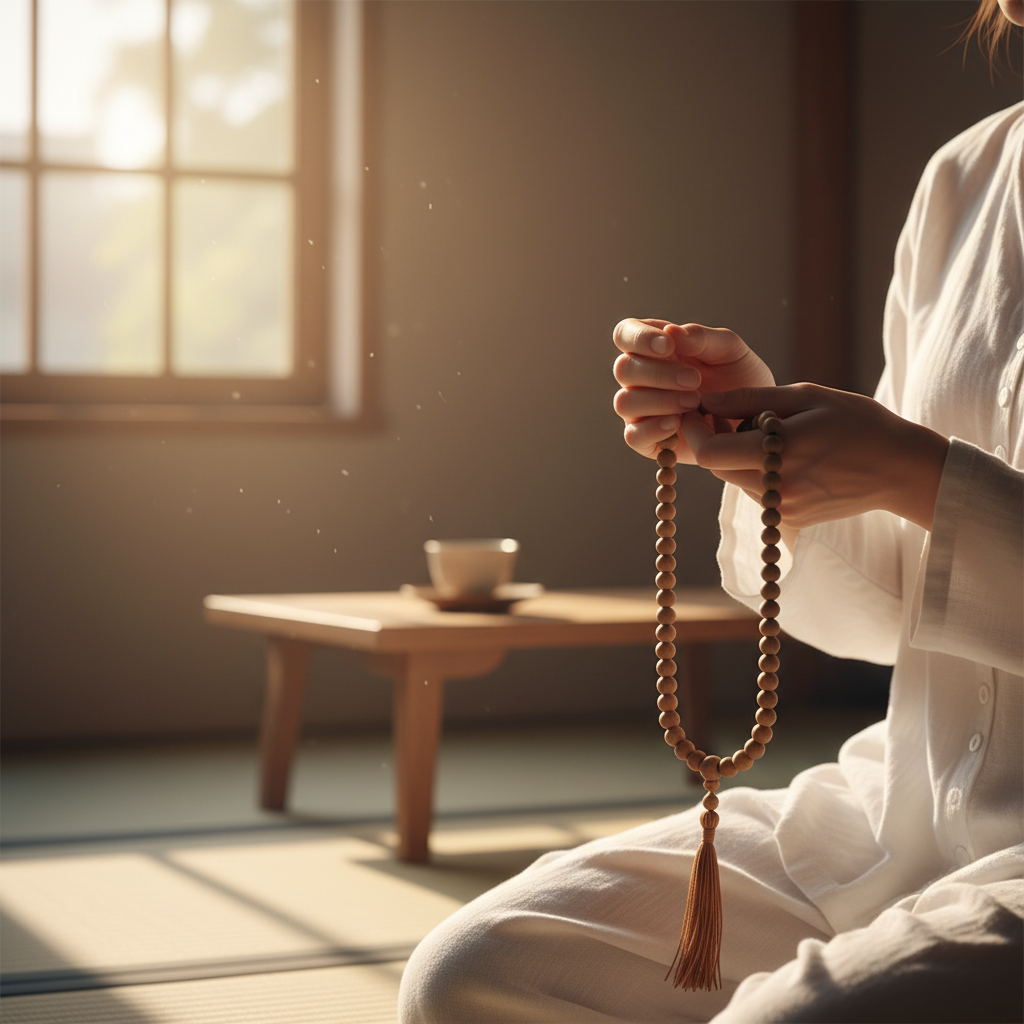
- Hold the mālā (rosary of 108 beads) in the right hand, between thumb and middle finger
- Start from the bead next to the meru (the larger central bead)
- With each repetition, pull one bead toward you
- Upon completing the round, do not cross the meru — reverse direction
- Maintain attention on the sound and meaning
- When the mind wanders — and it will — return without judgment
Three levels of japa: - Vaikharī — aloud (good for beginners) - Upāṃśu — whispered (intermediate) - Mānasa — mental (most subtle and powerful)
The natural progression is from outside to inside. Start aloud, gradually soften.
How long to practice
- Minimum: 1 mālā (108 repetitions, approximately 10-15 minutes)
- Ideal: 3 mālās (30-45 minutes)
- Intensive: 10+ mālās (retreat practice)
Regularity surpasses intensity. Ten minutes every day transforms more than two hours on the weekend.
What to expect
Expect nothing. Seriously. The expectation of "experiences" is the greatest obstacle. What happens with regular practice:
- A more stable and less reactive mind
- Greater capacity for concentration
- Healthy distance from thoughts
- Preparation for the study of Vedānta
None of these things happen all at once. It is gradual, cumulative, and silent. One day you notice something changed — without knowing exactly when.
To understand the relationship between mantra and the path of Vedānta, read Mantra and Meditation: How to Use According to Vedānta.
Want to study Vedanta in depth?
Join a Study Group →