
Sanskrit mantras carry meanings that get lost when translated hastily. Each syllable has been preserved for millennia with surgical precision — and there's a reason for that.
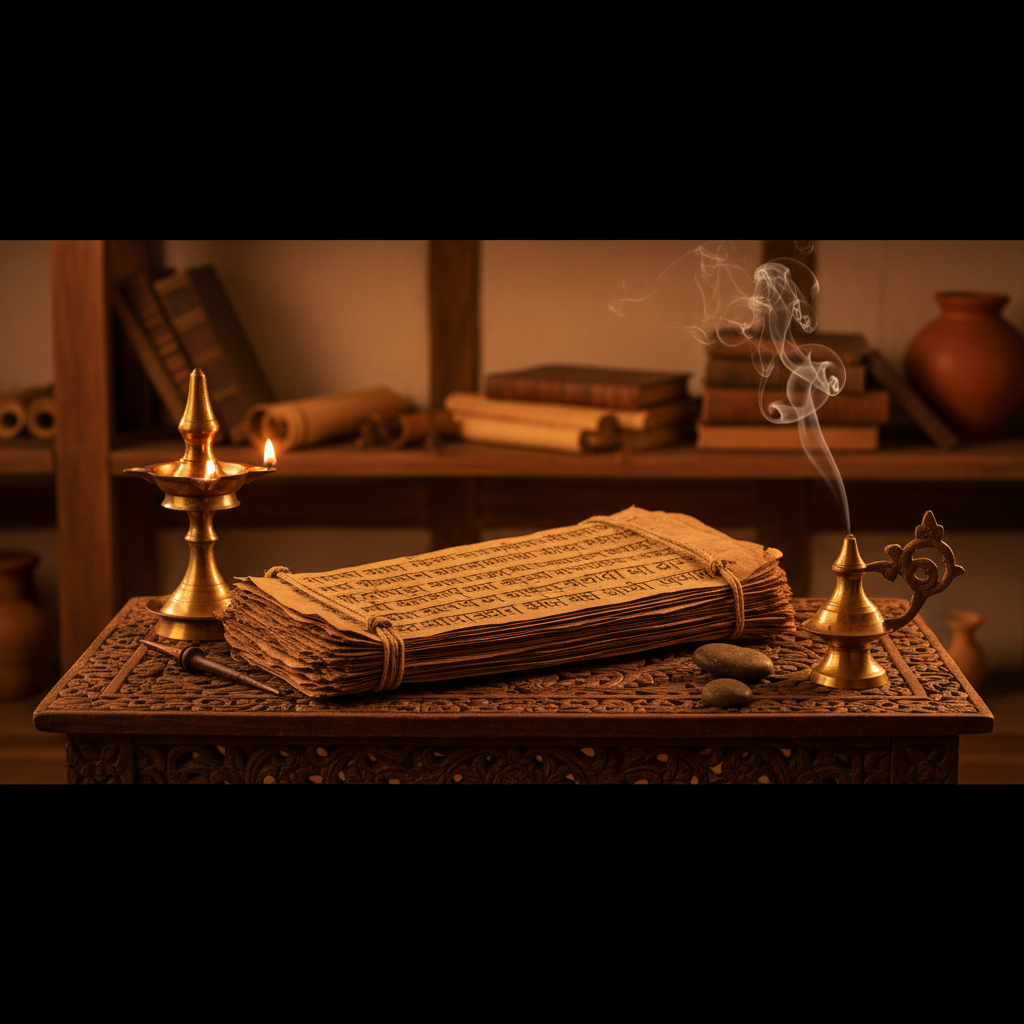
In this article, I present the most important mantras from the Vedic tradition with transliteration, real meaning, and context of use. This is not a mystical list — it's a guide for those who want to understand what they are reciting.
Why Sanskrit Matters
Sanskrit mantras are not "more magical" than other sounds. But Sanskrit has a unique characteristic: it's a language in which sound and meaning are intimately connected. Panini's grammar (4th century BC) codified this relationship with a precision that modern linguists still study.
When you recite a Sanskrit mantra, you are not just saying words. You are activating a sound structure that was designed to produce a specific effect on the mind. That's why correct pronunciation (uccarana) is so emphasized.
This doesn't mean you need to be fluent in Sanskrit to practice. It means it's worth learning the basic pronunciation and understanding the meaning of what you recite.
The Most Important Mantras
1. Omkara (Pranava)
The primordial mantra. It represents totality — Brahman. Composed of three phonemes (A-U-M) that symbolize the three states of consciousness and the reality that permeates them.
Source: Mandukya Upanisad, Chandogya Upanisad, Bhagavad Gita
Full article: Mantra Om: Meaning and How to Practice
2. Gayatri Mantra
Om bhur bhuvah svah tat savitur varenyam bhargo devasya dhimahi dhiyo yo nah pracodayat
"We meditate on the glorious light of the divine Savitri (the Sun as the principle of consciousness). May it inspire and guide our intellects."
This is the most revered mantra of the Vedas. It appears in the Rg Veda (3.62.10). It is recited daily by millions of people. It is not a request — it is a contemplation: may the cosmic intelligence that illuminates everything also illuminate my mind.
3. Panca-aksara (Om Namah Sivaya)
Om Namah Sivaya
"Om — I bow to the auspicious reality (Siva)."
Five syllables (na-mah-si-va-ya) that represent the five elements (earth, water, fire, air, space). Siva here is not a mythological figure — it is the name for the fundamental reality that is intrinsically auspicious (sivam).
Source: Sri Rudram (Yajur Veda), Siva Purana
4. Asta-aksara (Om Namo Narayanaya)
Om Namo Narayanaya
"Om — I bow to the one who dwells in all beings (Narayana)."
Eight syllables. Narayana comes from "nara" (human being, individual consciousness) + "ayana" (dwelling place). Isvara resides in everything that exists. It is not far away, in the sky. It is here, now, as you.
Source: Narayana Suktam (Yajur Veda), Visnu Purana
5. Maha-mrtyunjaya Mantra
Om tryambakam yajamahe sugandhim pustivardhanam urvarukam iva bandhanat mrtyormuksiya ma'mrtat
"We worship the three-eyed Being, fragrant, who nourishes all beings. Just as a ripe cucumber naturally releases itself from the vine, may it liberate us from death — but not from immortality."
The image of the cucumber (urvaruka) is key: liberation is natural, like a fruit that ripens. It is not forced, it is not violent. It is the result of maturity.
Source: Rg Veda (7.59.12)
6. Asato ma sadgamaya
Om asato ma sadgamaya / tamaso ma jyotirgamaya / mrtyorma amrtam gamaya
"From the unreal, lead me to the real. From darkness, lead me to light. From death, lead me to immortality."
This mantra from the Brhadaranyaka Upanisad (1.3.28) is one of humanity's most beautiful prayers. It is not a request for things — it is a request for knowledge. Immortality here is not living forever. It is recognizing that you are already that which does not die.
7. Sahana vavatu
Om sahana vavatu / sahanau bhunaktu / saha viryam karavavahai / tejasvinavadhitamastu / ma vidvisavahai / Om santih santih santih
"Om, may He protect us together. May He nourish us together. May we work together with vigor. May our study be luminous. May there be no hostility between us. Om peace, peace, peace."
This santi-patha (peace invocation) is recited at the beginning of Vedic studies. Teacher and student together ask for the learning environment to be free of obstacles. It is beautiful in its simplicity.
Source: Taittiriya Upanisad
8. Purnamadah
Om purnamadah purnamidam purnat purnamudacyate / purnasya purnamadaya purnamevavasisyate
"That is complete. This is complete. From the complete, the complete arises. Taking the complete from the complete, the complete remains."
This is perhaps the most profound mantra in all of Vedic literature. It summarizes Vedanta in four lines: reality is purna (complete/full). Nothing can be added to or removed from it. You already are that.
Source: Isa Upanisad (invocation)
Pronunciation: The Basics
Some essential tips:
* Short 'a' (like "a" in "father") vs. long 'ā' (sustained "aa") * Retroflex 'ṣ' (tongue on the palate) vs. palatal 'ś' (like "sh") vs. dental 's' (like a normal "s") * Visarga (final 'ḥ') — a soft aspirated sound at the end of words * Anusvara (nasal 'ṃ') — a nasalized "m", vibrating in the nasal cavity
Practice with a teacher is irreplaceable. Recordings help, but live correction makes a difference.
Context Matters More Than Repetition
The Yoga Sutra states: "taj-japas tad-artha-bhavanam" — repetition should be accompanied by contemplation of the meaning. Repetition without understanding is vocal exercise, not sadhana.
Before practicing any mantra, understand what it means. This is not intellectualism — it is respect for the practice and for yourself.
To understand how mantra connects with the complete path of Vedanta, read What is Mantra? and Mantra and Meditation According to Vedanta.
Want to study Vedanta in depth?
Join a Study Group →