
Meditation produces measurable changes in the brain — neuroscience documents this with increasing rigor — but Indian tradition has always known that the goal goes far beyond the brain.
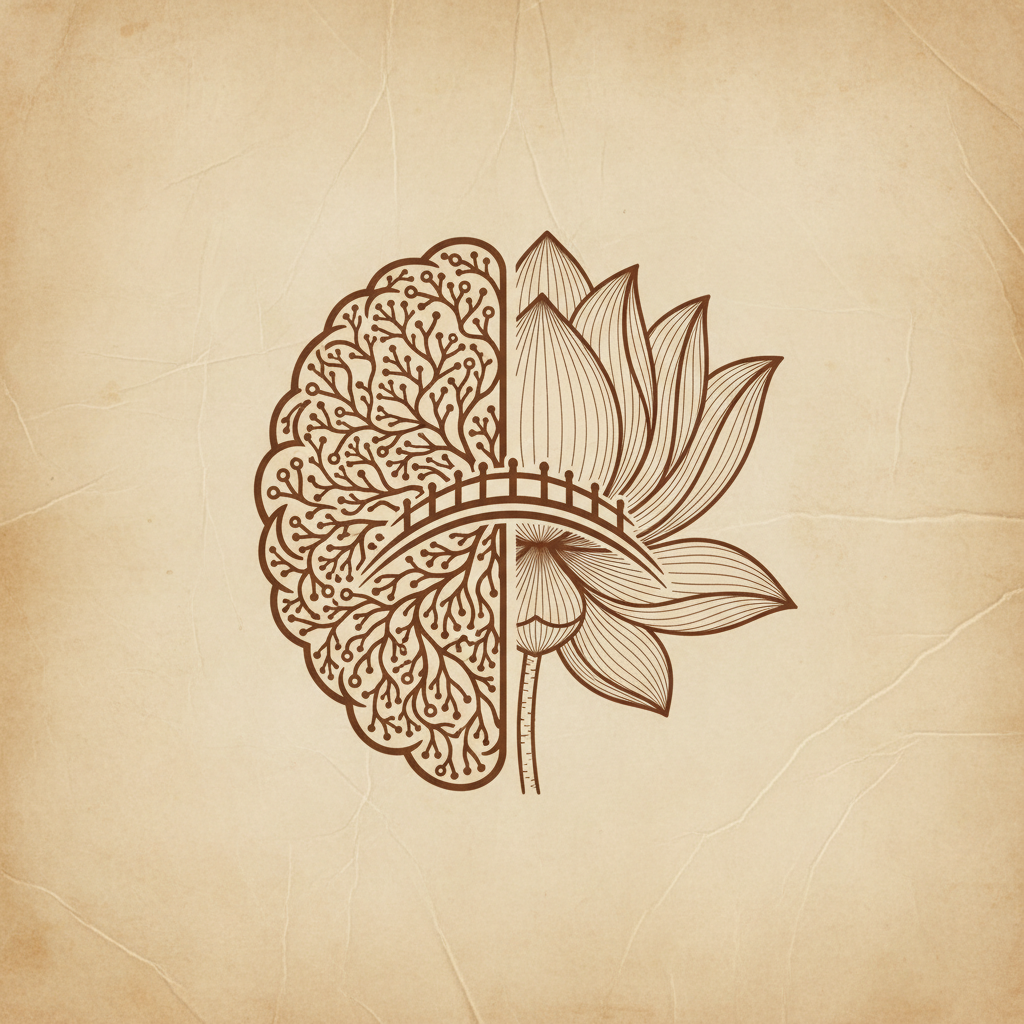
In the last 20 years, research on meditation has exploded. Harvard, Stanford, Max Planck — the world's top research centers are publishing studies on how meditative practice alters brain structure and function. And the results are consistent.
But — and this 'but' is fundamental — science measures what it can measure. And what tradition describes as the true goal of meditation doesn't fit into a scanner.
What Neuroscience Has Found
Structural Changes
Neuroimaging studies (fMRI and EEG) show that regular meditators exhibit:
- Increased gray matter in the prefrontal cortex (planning, decision-making)
- Thickening of the hippocampus (memory, learning)
- Reduction in the amygdala (processing of fear and stress)
- Greater connectivity between brain regions associated with attention and emotional regulation
A famous study by Sara Lazar (Harvard, 2005) showed that experienced meditators had thicker cortex in regions associated with attention and sensory integration — and that this difference persisted even with age.
Functional Changes
- Reduced activity in the Default Mode Network (DMN) — the brain network active when the mind wanders. Meditators have less "wandering mind" — and when the mind wanders, they return faster.
- Increased alpha and theta waves — associated with alert relaxation and creativity.
- Better cortisol regulation — the stress hormone decreases with regular practice.
- Changes in gene expression — yes, meditation can influence which genes are activated or silenced, particularly genes linked to inflammation.
How Long Does It Take?
Studies suggest that measurable changes appear with: - 8 weeks of regular practice (20-30 min/day) — significant reductions in stress markers - Months to years — more pronounced structural changes - Thousands of hours — the most dramatic changes (like those seen in Tibetan monks) require intensive practice for decades
What Tradition Has Always Known
None of this surprises tradition. When yoga texts speak of the effects of meditation, they describe exactly what science is documenting — only with different language.
Patañjali's Yoga Sūtra describes that practice (abhyāsa) leads to citta-vṛtti-nirodha — the cessation of mental fluctuations. In neuroscientific language: reduction of Default Mode Network activity.
Vedānta texts describe that a sāttvic mind — calm, clear, receptive — is the necessary instrument for self-knowledge. This corresponds exactly to what science calls "enhanced attentional and emotional regulation."
Tradition knew. It didn't need a scanner to know. But it's good that science confirms it — because it validates the method for those who need empirical evidence.
Where Science Stops (and Tradition Continues)
Here's the point that most articles about "meditation and the brain" ignore: tradition does not meditate to change the brain.
The brain changes are side effects — not the goal. The goal, according to Vedānta, is mokṣa — the understanding of who you truly are. And this understanding is not a brain state. It is the recognition that you are the consciousness that illuminates all brain states.
Science measures: - Neural activity - Brain structure - Hormonal responses - Observable behavior
Tradition points to: - The knower behind neural activity - The consciousness that is present even when the brain changes - Freedom that does not depend on any state
This is not anti-scientific. It is recognizing the limits of the scientific method. Science studies objects of experience. Consciousness is not an object — it is what makes all objects possible.
The Three Stages of Meditation in Tradition
Tradition describes three stages — and each has a different relationship with what science can measure.
1. Dhāraṇā — concentration
Fixing the mind on an object (breath, mantra, image). Science measures this well: focused attention, reduced distraction, activation of the prefrontal cortex.
2. Dhyāna — sustained meditation
Concentration becomes continuous, effortless. The mind flows to the object like oil being poured without interruption. Science documents: "flow" states, coherence between brain regions, sustained gamma waves.
3. Samādhi — absorption
The distinction between meditator, meditation, and object dissolves. Here, science begins to struggle — because the subject of the experience is not "observing" in the usual sense. Studies with advanced monks show extraordinary brain patterns, but what the person experiences in samādhi is not reducible to the neural pattern.
And here is the key point of Vedānta: samādhi is an experience. And no experience — however sublime — is mokṣa. Mokṣa is knowledge, not experience. Meditation prepares the instrument; knowledge is what liberates.
Mindfulness vs. Traditional Meditation
The "mindfulness" movement, popularized by Jon Kabat-Zinn, has extracted techniques from Buddhist tradition and secularized them for clinical contexts. Does it work? Yes — the studies are clear. MBSR (Mindfulness-Based Stress Reduction) reduces stress, anxiety, chronic pain.
But there are significant differences:
- Modern mindfulness is a self-regulation technique. The goal is to function better.
- [Traditional meditation](/blog/meditacao-vedanta-como-funciona) is part of a complete path. The goal is self-knowledge.
- Mindfulness stops at the experience. Tradition uses experience as preparation for knowledge.
No criticism of mindfulness — it's excellent for what it aims to do. But if you want what tradition offers, mindfulness is the beginning, not the end.
Meditation and the guṇas
Tradition explains the effects of meditation in terms of guṇas:
- Tamas decreases — less lethargy, confusion, procrastination
- Rajas decreases — less agitation, anxiety, impulsivity
- Sattva increases — more clarity, calm, discernment
Neuroscience translates: more active prefrontal cortex (planning, decision-making), less reactive amygdala (less stress), more regulated DMN (less rumination). Same reality, different languages.
Practical Advice
- Meditate. The evidence is irrefutable — it's good for the brain, the body, life. You don't even need a spiritual reason.
2. But don't stop there. If meditation is "just" for stress reduction, you're using an airplane as a bicycle. It works, but it wastes its potential.
3. Combine with study. Meditation without knowledge is concentration. Meditation with Vedānta study is an instrument of liberation.
4. Practice with guidance. The internet is full of techniques — and confusion. A qualified teacher knows which practice serves you, at this moment, with your mental configuration.
5. Don't be impressed by experiences. Lights, warmth, visions, ecstasy — all of this can happen. And all of this is experience in the body-mind. You are not the body-mind. The brain that changes in meditation — you are the consciousness that knows about the brain.
Neuroscience shows that meditation changes the brain. Tradition shows that you are not the brain. Both are true — and together, they point to something extraordinary: the tool that transforms the instrument reveals that the one using the instrument never needed to be transformed.
Want to study Vedanta in depth?
Join a Study Group →