
In Vedanta, prāṇa is the vital force that animates the entire body-mind — respiration is merely its most visible manifestation, not its entirety.
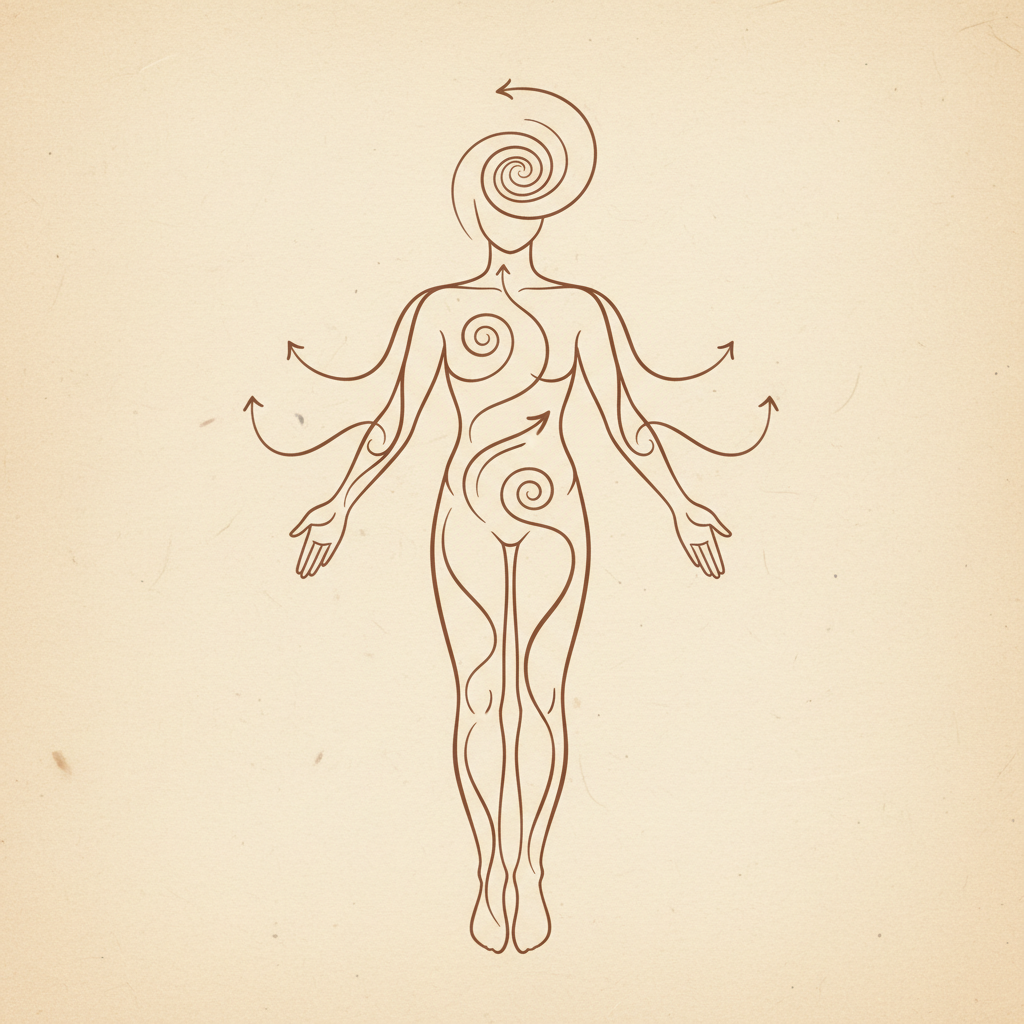
"Prāṇa is vital energy." You've heard this a thousand times. And it's not wrong — but it's so vague that it loses its usefulness. In popular culture, prāṇa has become synonymous with anything vaguely related to "energy": reiki, chakras, "good vibes."
In Vedanta, prāṇa has a precise technical meaning. And understanding this meaning changes how you relate to your body, your mind, and your practice.
Prāṇa in the Vedantic Context
In the Upaniṣads, prāṇa is extensively discussed. The Praśna Upaniṣad dedicates two of its six chapters to prāṇa. The Chāndogya and Bṛhadāraṇyaka also offer fundamental teachings.
What do these sources say?

Prāṇa is the principle of animation. It is what makes the difference between a living body and a dead body. When prāṇa operates, there is life — breathing, digestion, circulation, thought. When prāṇa departs, the body disintegrates.
But prāṇa is not consciousness. This is a crucial point. Prāṇa is subtle matter (prakṛti) — it is part of the subtle body (sūkṣma-śarīra). It is inert in the Vedantic sense: it depends on consciousness (cit) to function, just as a machine depends on electricity.
The Five Prāṇas
Vedanta (and Yoga) classify five functions of prāṇa:
Prāṇa (in the specific sense) — governs respiration and ingestion. Operates in the chest region. It is the force that draws air in, that accepts food, that receives.
Apāna — governs elimination and expulsion. Operates in the lower abdominal region. It is the force that pushes out — exhalation, excretion, childbirth.
Vyāna — governs distribution and circulation. Permeates the entire body. It carries nutrients, blood, and energy to all parts.
Udāna — governs upward movement. Operates in the throat and head. Responsible for speech, belching, and — at the moment of death — for the departure of prāṇa from the body.
Samāna — governs assimilation and digestion. Operates in the navel region. It equalizes what enters, processes, and distributes.
These five are not separate entities. They are functions of a single prāṇa — like a river that irrigates through various channels.
Prāṇa and Mind
Here's something most practitioners don't realize: prāṇa and mind are intimately linked.
The Haṭha Yoga Pradīpikā states: "When prāṇa moves, citta (mind) moves. When prāṇa is still, citta is still." This is why prāṇāyāma works as preparation for meditation. It's not mysticism — it's the functional relationship between breath and mental activity.
Observe this in yourself. When you are anxious, your breath is short and rapid. When you are calm, it is long and smooth. The relationship is bidirectional: the mental state affects the breath and the breath affects the mental state.
Prāṇāyāma is not "beautiful breathing." It is using the breath as a lever for the mind.
Prāṇa and the Kośas
In the Vedantic analysis of the five layers (pañca-kośa) from the Taittirīya Upaniṣad, prāṇa occupies the second layer:
Annamaya-kośa — physical body (food) Prāṇamaya-kośa — vital body (prāṇa) Manomaya-kośa — mental body (mind) Vijñānamaya-kośa — intellectual body (intellect) Ānandamaya-kośa — bliss body
The kośas are not like layers of an onion. They are degrees of subtlety. Prāṇa permeates the physical body and is permeated by the mind. And through all the kośas shines ātman — the consciousness that you are.
The purpose of the kośa analysis is precisely this: to show that you are none of them. You are not the body, not prāṇa, not the mind, not the intellect, not the experience of bliss. You are what is present in all and is not limited by any.
The Teaching of the Kauṣītaki Upaniṣad
There is a classic story. The sense organs argue about who is most important. Each claims "I am essential." Vision leaves the body — the body continues living, blind but alive. Hearing leaves — it continues, deaf but alive. One by one, they all leave.
When prāṇa announces it will leave, all the organs begin to be pulled out along with it — like twigs stuck to a horse getting up. They all plead: "Stay! You are the greatest among us."
This narrative illustrates that prāṇa is the functional foundation of life. Without prāṇa, no organ operates. It is what gives life to the body.
But — and this is the Vedantic subtlety — prāṇa only functions because consciousness animates it. Prāṇa is the greatest of the organs, but it is not ātman. It is an instrument, not the subject.
Prāṇa in Practice
How does this change your practice?
If you practice prāṇāyāma, do so with the understanding that you are working with a real force — not "mystical energy." Prāṇa is functional, observable, analyzable.
If you meditate, realize that calming prāṇa (through the breath) calms the mind. It's not an obligatory prerequisite, but it helps enormously.
If you study Vedanta, understand that prāṇa is part of what you are not — and recognizing this clearly is part of the path of self-knowledge.
Prāṇa is not you. But without understanding prāṇa, you confuse the instrument with the musician. And the resulting music becomes confused.
The breath is the gateway. What lies beyond it — the consciousness that animates prāṇa, that animates the body, that illuminates the mind — that is what Vedanta invites you to discover.
Want to study Vedanta in depth?
Join a Study Group →