
Sāṃkhya is the philosophical basis of Yoga — understanding Sāṃkhya transforms your practice from physical exercise into an investigation into the nature of reality.
If you practice yoga and have never heard of Sāṃkhya, you are missing the foundation. Patañjali's Yoga is not an independent system — it is the practical application of the Sāṃkhya worldview. Without this context, āsanas become gymnastics and meditation becomes a relaxation technique.
Let's rebuild this foundation.
Origin and Founder
Sāṃkhya is attributed to the sage Kapila, one of the oldest figures in the Indian philosophical tradition. The classic text is Īśvarakṛṣṇa's Sāṃkhya-kārikā (3rd-4th century), which systematizes the school in 72 dense verses.
The word sāṃkhya comes from saṃkhyā — "enumeration" or "counting." The system is so named because it enumerates and classifies the fundamental principles of reality. There are 25 tattvas (principles) in total.

The Two Fundamental Principles
Sāṃkhya proposes a radical dualism: all reality is reduced to two irreducible principles.
Puruṣa — pure consciousness. It does not act, does not change, does not suffer. It is the silent witness of all experience. If you've ever wondered "who observes my thoughts?", you are touching puruṣa.
Prakṛti — primordial matter. Everything that changes, everything that has form, everything that can be experienced. From the subtlest thought to the densest stone — everything is prakṛti.
The human problem, according to Sāṃkhya, is the confusion between puruṣa and prakṛti. You (consciousness) identify with the body-mind (matter) and suffer the consequences.
The Three Guṇas
Prakṛti is not inert matter. It is dynamic, composed of three qualities (guṇas) that are always interacting:
Sattva — clarity, lightness, knowledge. When sattva predominates, the mind is lucid, serene, open to learning.
Rajas — activity, agitation, desire. When rajas predominates, the mind is restless, seeking, projecting.
Tamas — inertia, heaviness, obscurity. When tamas predominates, the mind is confused, lethargic, resistant.
In equilibrium (sāmyāvasthā), the three guṇas cancel each other out and prakṛti remains unmanifest. When the equilibrium is broken, manifestation begins — the universe arises.
The Bhagavad Gītā dedicates an entire chapter (the 14th) to the guṇas. If you want to understand how they operate in practical life, this is a good starting point along with the study of the Gītā.
The 25 Tattvas: The Map of Reality
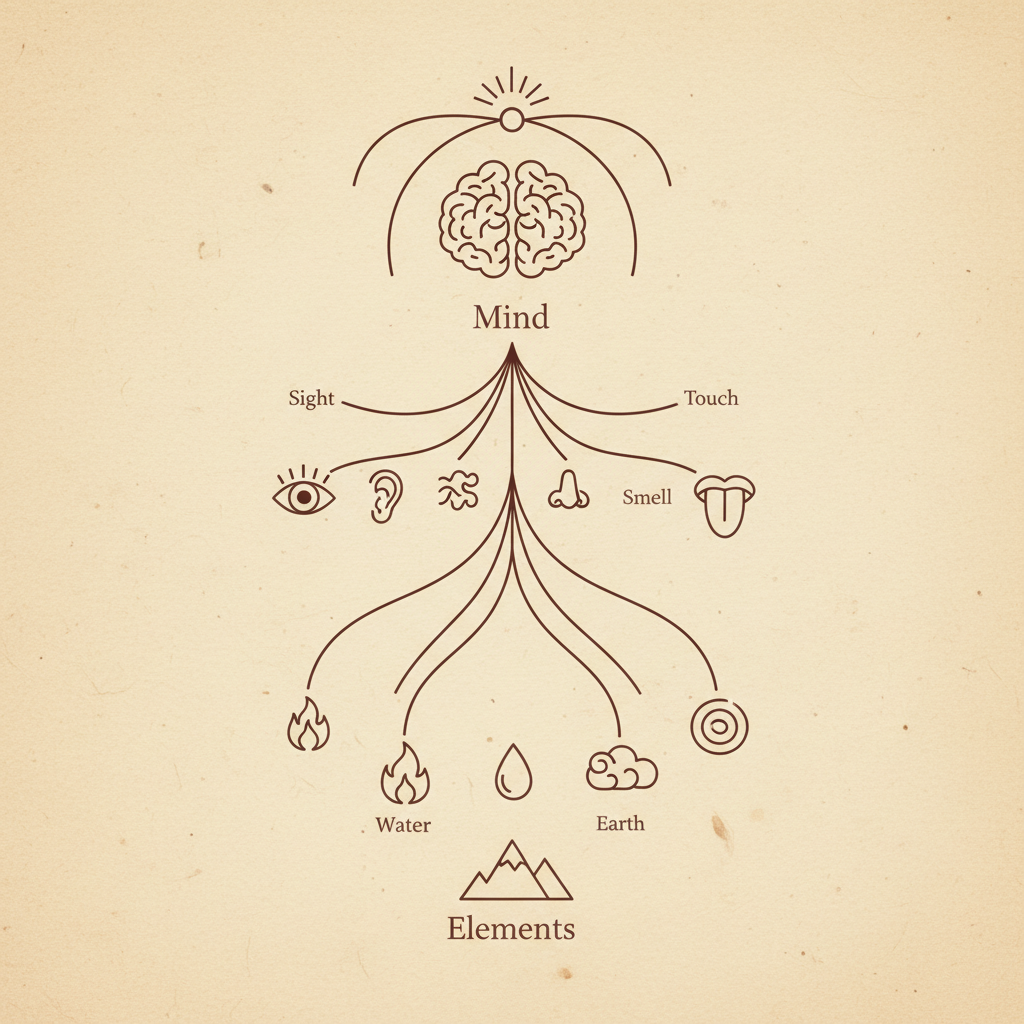
From prakṛti, Sāṃkhya enumerates 23 evolutes — plus puruṣa, totaling 25 tattvas:
From prakṛti arises mahat (cosmic intelligence, buddhi in the individual). From mahat arises ahaṃkāra (the principle of individuation — the ego).
From ahaṃkāra, two lines of evolution:
Through the sattvic aspect: the 5 organs of perception (jñānendriyas — ear, skin, eye, tongue, nose), the 5 organs of action (karmendriyas — speech, hands, feet, excretion, reproduction), and manas (operational mind).
Through the tamasic aspect: the 5 subtle elements (tanmātras — sound, touch, form, taste, smell) and, from them, the 5 gross elements (mahābhūtas — space, air, fire, water, earth).
It is a complete map. Everything you experience — thoughts, emotions, sensations, objects — fits into this classification.
The Problem: Identification
Puruṣa is pure consciousness. It does not suffer, does not act, does not change. But through a "reflection" in buddhi (intellect), puruṣa appears to be involved in the world.
It's like sunlight reflected on water. The water moves, and the sun's reflection seems to move. But the sun is still.
When puruṣa "confuses" itself with buddhi, ahaṃkāra, and manas, the experience of the suffering individual — the jīva — arises. Every search for happiness, every fear, every lack is a result of this confusion.
The Solution: Viveka-khyāti
Liberation (kaivalya) in Sāṃkhya comes through discernment (viveka). Not through action, ritual, or mystical experience. When puruṣa and prakṛti are clearly distinguished — when you see that consciousness is not the body, not the mind, not the emotions — the confusion ceases.
This discernment is not intellectual. It is existential. It changes how you experience yourself.
Sāṃkhya and Yoga: The Connection
Patañjali's Yoga Sūtras adopt the Sāṃkhya cosmology almost entirely. The guṇas, the tattvas, the puruṣa-prakṛti distinction — everything is there.
What Patañjali adds is the practical method for achieving discernment: the disciplines of yama, niyama, āsana, prāṇāyāma, pratyāhāra, dhāraṇā, dhyāna, and samādhi.
Sāṃkhya says "what it is." Yoga says "how to get there."
Sāṃkhya and Vedānta: Where They Diverge
Vedānta agrees with much of Sāṃkhya — it uses the vocabulary of the guṇas, recognizes the importance of viveka, accepts that identification with the body-mind is the problem.
But there is a fundamental divergence: Vedānta does not accept dualism. For Vedānta, puruṣa and prakṛti are not two independent realities. Prakṛti is the power (śakti) of Brahman. There is only one reality — not two.
Sāṃkhya says: "you are puruṣa, separate from prakṛti." Vedānta says: "you are Brahman, and prakṛti is its expression."
This is not a minor difference. It changes what liberation means. In Sāṃkhya, it is separation (kaivalya). In Vedānta, it is recognition of unity (mokṣa).
Why Study Sāṃkhya Today?
Because the vocabulary is indispensable. Guṇas, tattvas, puruṣa, prakṛti — these terms appear throughout yogic and Vedantic literature. Without Sāṃkhya, you read the Gītā and don't understand half of it.
And because the map is useful. Knowing how to distinguish sattva from rajas from tamas in your own mind is a powerful practical tool. It allows you to make better choices — regarding food, company, activities, environments.
Sāṃkhya is the ground on which Yoga rests. Stand firmly on this ground, and the entire practice transforms.
Want to study Vedanta in depth?
Join a Study Group →