
If you've heard of spiritual retreats, you probably imagine silence, meditation, and nature. All of that exists in a Vedanta retreat. But there's something more: systematic knowledge.
A retreat at a Gurukulam isn't about "having experiences." It's about understanding who you are — using a method that has existed for thousands of years.
What is a Gurukulam?
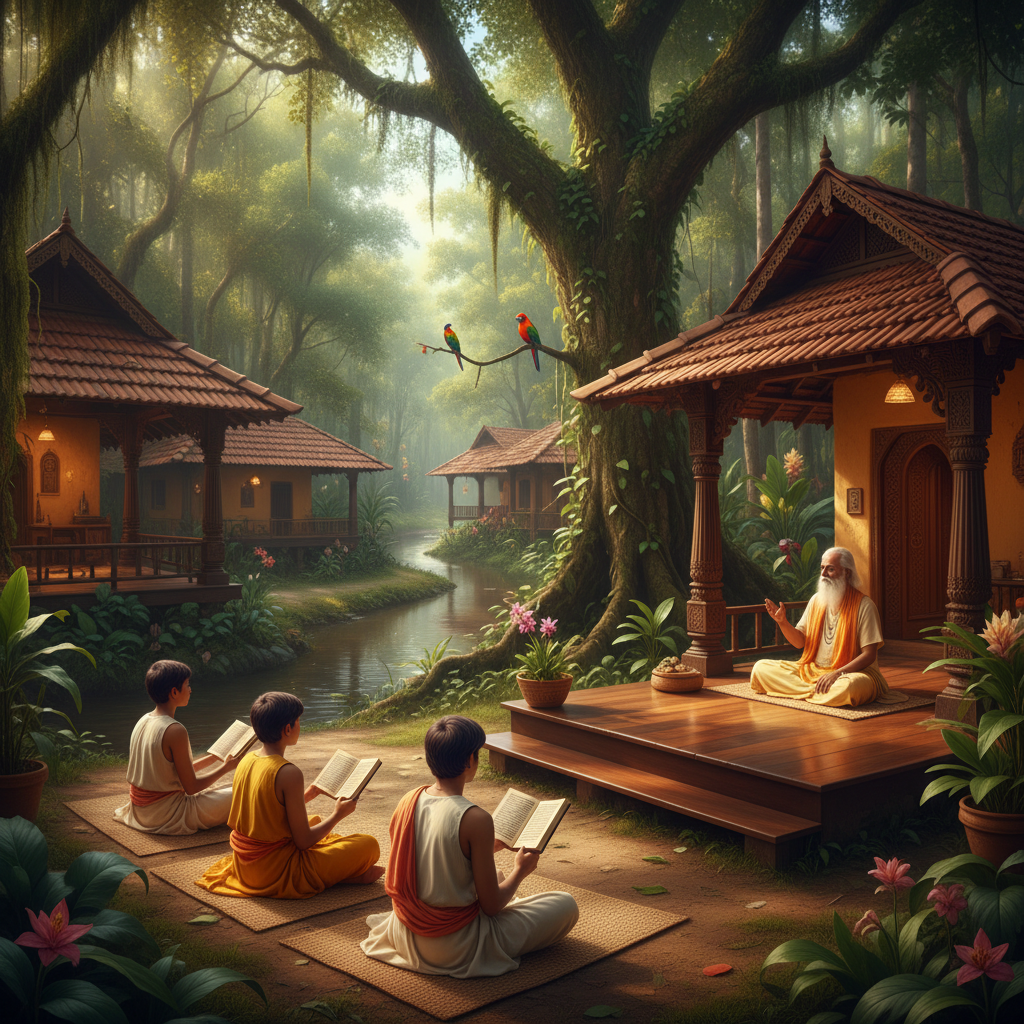
Gurukulam (guru + kulam = teacher's family) is the traditional teaching model from India. The student lives alongside the teacher, in an environment dedicated to study and practice.
It's not a monastery. It's not a school in the modern sense. It's a space for transformation through knowledge, where daily living with the teacher and the community is an integral part of learning.
How does a Vedanta Retreat Work?
The typical structure of a Vedanta retreat at a Gurukulam includes:
Daily Routine
- 5:30 AM — Wake up
- 6:00 AM — Meditation and chanting (Vedic chants)
- 7:00 AM — Class 1: Main text (Bhagavad Gita, Upanisads, or Brahma Sutra)
- 8:30 AM — Breakfast
- 10:00 AM — Class 2: Complementary text or practice (guided meditation, pranayama)
- 12:00 PM — Lunch
- 2:00 PM — Personal study time
- 4:00 PM — Class 3: Question and answer session (satsanga)
- 6:00 PM — Evening chanting
- 7:00 PM — Dinner
- 8:00 PM — Meditation or free study
- 9:30 PM — Lights out
The Teaching Method
Vedanta isn't taught like a school subject. The teacher (acarya) uses a method called adhyaropa-apavada — superimposition and negation. Simply put:
- First, the teacher shows you what you think you are (body, mind, emotions).
- Then, they systematically remove each mistaken identification.
- What remains is what you truly are: pure consciousness (atman).
This process requires time, repetition, and a teacher who knows the method. That's why the retreat format is so effective — you have daily access to the teaching.
What Makes a Vedanta Retreat Different?
1. It's Not Experience-Based
Most retreats promise "transformative experiences." Vedanta promises no experience at all. It promises understanding — which is deeper and more lasting.
Experiences come and go. Knowledge remains.
2. It Has a Method
It's not a teacher sharing their opinions. It's a tradition with a method (sampradaya). The text and the master are key — the teacher is the medium. This ensures consistency and depth.
3. Qualified Teacher
In Vedanta, the teacher isn't someone who "achieved enlightenment" and now speaks from experience. They are someone who has systematically studied with their own teacher and mastered the teaching method. Qualification comes from tradition, not charisma.
Who is it For?
A Vedanta retreat is ideal for those who:
- Already have an interest in spirituality but want depth beyond isolated practices.
- Seek answers (not just temporary peace).
- Want to understand the classic texts (Gita, Upanisads) with a teacher.
- Have emotional maturity to question deep-seated beliefs about themselves.
- Are willing to study — not just sit and meditate.
What to Expect Emotionally
I'll be direct: Vedanta retreats can be emotionally intense. Not because anyone pressures you, but because the teaching questions everything you think about yourself.
It's normal to: - Feel resistance (the mind doesn't want to let go of its identifications). - Have moments of confusion (it's part of the process). - Cry for no apparent reason (repressed emotions find space to emerge). - Have deep insights followed by doubts (this is healthy).
The teacher is there to guide you through all of this. Trust the process.
Gurukulam in Brazil
The Gurukulam model, though traditional to India, already exists in Brazil. The Vishva Vidya Organization holds regular Vedanta study activities, including immersion retreats.
The retreats take place in person, in environments suited for study — away from the city, in contact with nature, with facilities for accommodation and meals.
For information on upcoming retreats: vedanta.com.br/retiros
How to Prepare for a Vedanta Retreat
- Read the Bhagavad Gita — even a simple translation helps you familiarize yourself with the concepts.
- Watch introductory classes — there's a lot of material available online.
- Practice meditation — 15-20 minutes daily helps prepare the mind for study.
- Go without expectations — knowledge works at its own pace.
- Bring a notebook — you'll want to take notes.
What You Take Home
It's not a mystical experience that fades over time. It's clarity about who you are — and that has no expiration date.
Many people report that after a Vedanta retreat: - Anxiety significantly decreases (because insecurity about oneself diminishes). - Relationships improve (because you stop projecting your unmet needs onto others). - Decisions become clearer (because you know what you truly want). - Meditation practice deepens (because it now has context and purpose).
Life doesn't magically change. But the way you relate to it changes — and that changes everything.
Want to study Vedanta in depth?
Join a Study Group →