
If you type "hatha yoga" into Google, you will find descriptions like "gentle posture practice," "yoga for beginners," or "sequence of āsanas with breathing." None of these descriptions is wrong in the modern context. But none of them captures what Hatha Yoga truly is — or was.
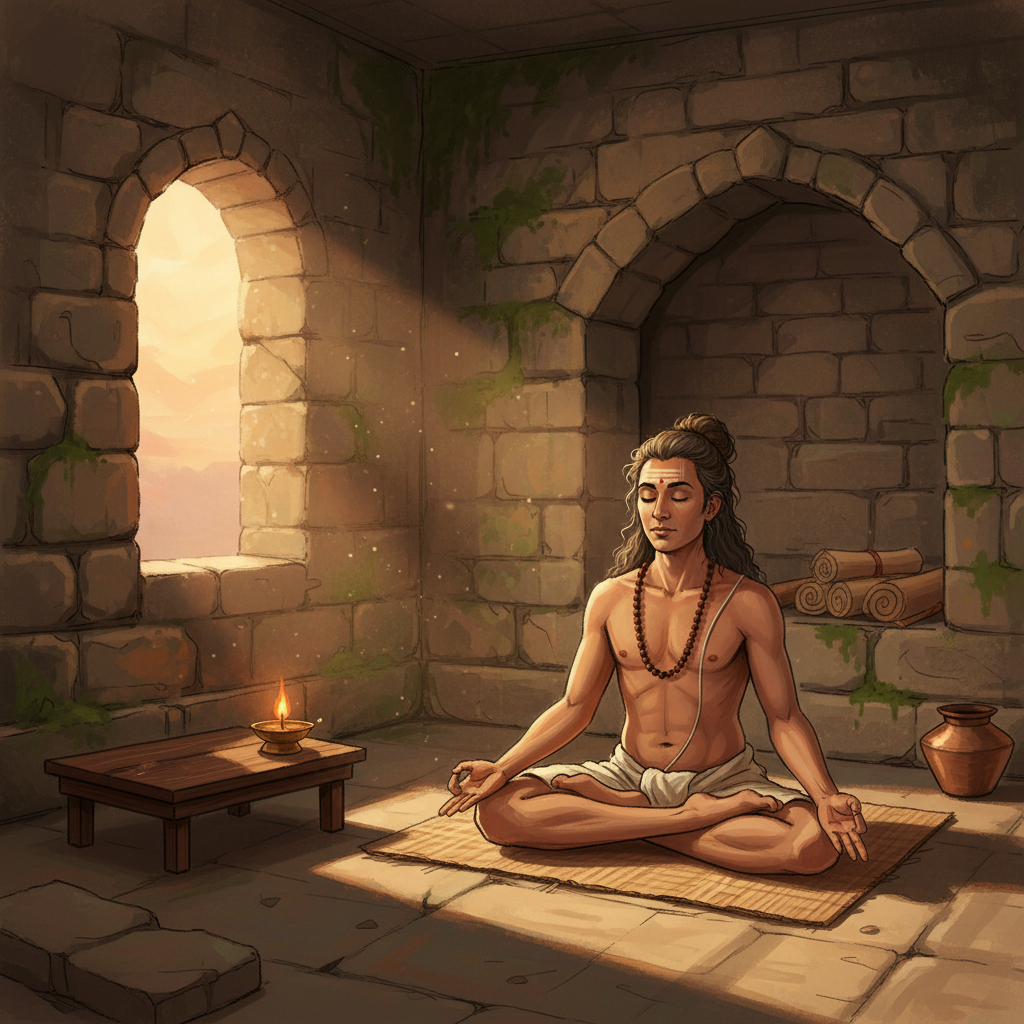
The word Hatha
Haṭha (हठ) in Sanskrit has two complementary meanings:
The first is "force" or "intense effort." Haṭha-yoga is the yoga that demands firm discipline with the body and breath. It is not the "gentle" path — it is the path that uses the body as the primary instrument of transformation.
The second comes from a symbolic etymology: ha = sun (prāṇa, vital energy) and ṭha = moon (apāna, descending energy). Haṭha-yoga is the union of these two forces — the balancing of energies in the subtle body.
Neither meaning has anything to do with "doing beautiful postures on Instagram."
The original context: the Nātha Yogīs
Hatha Yoga as a codified system appears between the 10th and 15th centuries CE, associated with the tradition of the Nātha Yogīs — a lineage of practitioners that included figures such as Gorakṣanātha and Matsyendranātha.
The classic texts are:
- Haṭha Yoga Pradīpikā (15th century) — by Svātmārāma
- Gheraṇḍa Saṃhitā (17th century)
- Śiva Saṃhitā (15th-17th century)
If you read these texts, you will notice something that surprises those who only know modern yoga: āsana (postures) occupies a minimal fraction. The majority deals with prāṇāyāma (breath control), mudrās (energetic seals), bandhas (body locks), and purification practices (ṣaṭkarma).
What Hatha Yoga actually taught
The Haṭha Yoga Pradīpikā is direct about the goal of the practice. The text opens with:
"Haṭha-yoga is offered as a staircase for those who wish to reach the heights of rāja-yoga."
In other words: Hatha Yoga is not the final goal. It is a preparation. The goal is rāja-yoga — the state of samādhi, total absorption, which prepares the mind for knowledge.
The practices included:
1. Ṣaṭkarma — six purification actions for the body (neti, dhauti, nauli, basti, kapālabhāti, trāṭaka). Few modern studios even mention these practices.
2. Āsana — postures. The Haṭha Yoga Pradīpikā describes 15 āsanas. Not 200. Not 500. Fifteen. And the goal was not flexibility or fitness — it was stability for meditation.
3. Prāṇāyāma — breath control. This is the central practice of Hatha Yoga. It includes kumbhaka (retention), which the texts describe as the primary tool for awakening kuṇḍalinī.
4. Mudrā and Bandha — energetic seals and locks. Mahāmudrā, mahābandha, khecarī mudrā — advanced practices working with the subtle body (prāṇa, nāḍīs, cakras).

What happened in the West
In the 20th century, yoga arrived in the West — first as philosophy (Vivekananda, 1893), then as physical practice (Krishnamacharya and his students: B.K.S. Iyengar, Pattabhi Jois, Desikachar).
What happened was a natural market selection: āsana was the easiest part to package and sell. Advanced prāṇāyāma requires supervision. Ṣaṭkarma does not work as a group class. Mudrās and bandhas do not fit in an advertisement.
The result: "Hatha Yoga" became synonymous with "āsana class" — the smaller part of a much larger system. It is not that modern classes are bad. It is that they are a fraction of the whole.
Hatha Yoga and the subtle body
Something modern yoga almost never mentions: Hatha Yoga works with the subtle body (sūkṣma-śarīra). According to the tradition, the human being has:
- Sthūla-śarīra — the gross body (the physical)
- Sūkṣma-śarīra — the subtle body (prāṇa, mind, intellect)
- Kāraṇa-śarīra — the causal body (fundamental ignorance)
Āsanas work with the gross body. But prāṇāyāma, mudrās, and bandhas work directly with the subtle body — the energy channels (nāḍīs), the energy centers (cakras), and the vital force (prāṇa).
That is why the Haṭha Yoga Pradīpikā insists so much on prāṇāyāma. The gross body is the external instrument. The subtle body is where the real transformation happens.
Hatha Yoga today: what to recover
I am not saying you should abandon your yoga class. I am saying there is much more available than what most people practice.
If you already practice āsana, consider incorporating: - Prāṇāyāma — start with nāḍī śodhana (alternate nostril breathing) under guidance - Study of the texts — read at least the Haṭha Yoga Pradīpikā - Understanding the goal — Hatha Yoga prepares body and mind for self-knowledge
To understand how Hatha Yoga connects with the knowledge of Vedānta, read Hatha Yoga and Vedānta: the original connection. And to see what changed from classical to modern yoga, see Hatha Yoga vs Modern Yoga.
Want to study Vedanta in depth?
Join a Study Group →