
Vedanta says you don't die—not as a promise of an afterlife, but as a fact about the nature of who you truly are.
Death is the subject nobody wants to face. Even in spirituality, the tendency is to deflect: "don't think about it," "live in the present," "when the time comes, we'll see." Vedanta does the opposite. It places death at the center of inquiry—and uses this confrontation to reveal the most fundamental truth about who you are.
The Kaṭha Upaniṣad is the text that does this most directly.
Naciketas and Death
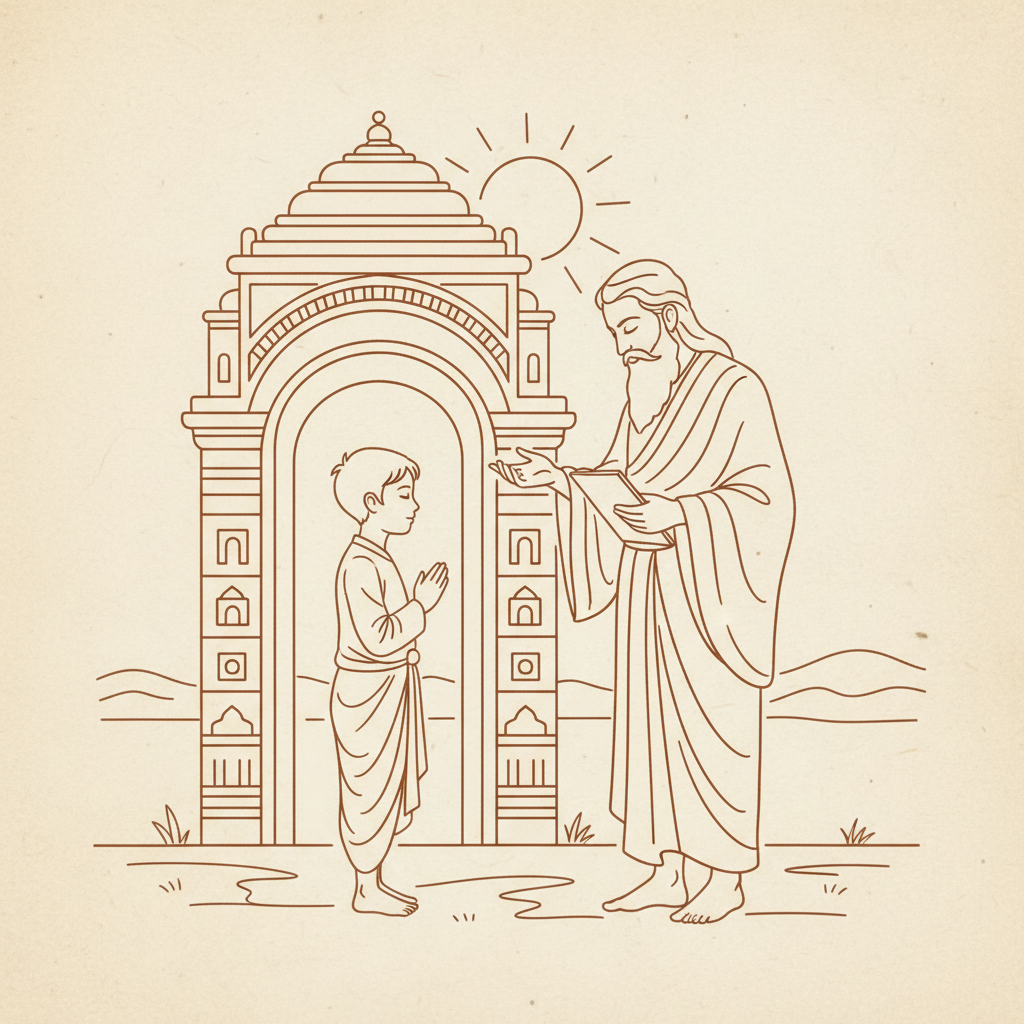
The Kaṭha Upaniṣad begins with a story. Naciketas, a boy, is sent to the abode of Yama (the lord of death) by his own father, in a fit of anger. Naciketas waits three days at Yama's door—and when Yama finally appears, ashamed to have kept a guest waiting, he offers three boons.
The first two are simple. The third is the one that matters: "What happens after death? When a person dies, some say he exists and others say he does not. I want to know the truth."
Yama tries to deflect. He offers wealth, power, longevity. "Ask for something else. Even the devas doubt this." Naciketas doesn't yield. He insists. And Yama, recognizing a qualified student, teaches.
What Yama teaches is not a map of the hereafter. It is the knowledge of ātman.
The Central Teaching
"A-ṇor aṇīyān mahato mahīyān"—ātman is subtler than the subtlest, greater than the greatest. It cannot be measured, surrounded, or limited.
Ātman is not born. Ātman does not die. It did not come from anywhere. It is not going anywhere. It is eternal, unchanging, ever-present.
"Na jāyate mriyate vā kadācit"—it is never born, never dies.
This verse appears in both the Kaṭha Upaniṣad and the Bhagavad Gītā (2.20). It is Vedanta's central statement about death.
What Dies, Then?
The body dies. The mind dissolves. Memories cease. The personality you've built throughout life—that indeed ends.
Vedanta calls all this upādhi—limiting conditions. Body, mind, intellect are upādhis that make the unlimited appear limited. Like the space within a pot (ghaṭākāśa) seems different from total space (mahākāśa)—but when the pot breaks, the "inner" space doesn't die. It was never truly separate.
Death is the breaking of the pot. The space (ātman) is unaffected.
Death and Fear
Why are we afraid of death? Vedanta analyzes this with precision.
The fear of death is not fear of pain (that's fear of pain). It is fear of non-existence. "I will cease to be."
But who is this "I" that will cease to be? If you investigate, you discover it is the ego—ahaṃkāra—the identity built on body, mind, relationships, possessions.
This ego indeed ends with death. But you are not the ego. You are the consciousness in which the ego appears and disappears. And this consciousness is present in all states—waking, dreaming, deep sleep.
The fear of death is, at its root, ignorance about yourself. When ignorance is removed by knowledge, fear dissolves—not out of courage, but out of clarity.
Reincarnation in Vedanta
Vedanta accepts reincarnation as part of the model—but it doesn't celebrate it. The cycle of birth and death (saṃsāra) is precisely what knowledge aims to resolve.
What "reincarnates" is not you (ātman). Ātman goes nowhere. What transmigrates is the sūkṣma-śarīra (subtle body)—the bundle of tendencies (vāsanās), karmic memories, and dispositions that attaches to a new body.
It's like changing clothes. The clothes change, the wearer remains. But—and here's the point—the wearer was never affected by the clothes. Never truly limited by them.
Mokṣa is not stopping reincarnation. It is recognizing that you were never bound in the cycle. The cycle belongs to the body-mind. You are the witnessing consciousness of the cycle.
How Vedanta Deals with Grief
Vedanta doesn't say "don't feel." Emotions are natural, and grief is a legitimate response to loss. The body-mind will feel.
But Vedanta offers something no comfort offers: perspective. The person you lost is not the body that ceased. The body was a temporary vehicle. The reality of that person—ātman—is identical to the reality of everything, including you.
In the Gītā (2.11), Kṛṣṇa tells Arjuna: "You grieve for those who are not worthy of grief, and yet you speak words of wisdom. The wise grieve neither for the living nor the dead."
It's not insensitivity. It's the recognition that death is an event at the body level—not at the level of the real.
Death as a Teacher
The Kaṭha Upaniṣad does something brilliant: it uses death itself (Yama) as the teacher. The message is clear: confronting death honestly is the fastest path to self-knowledge.
As long as you avoid thinking about death, you live on the surface. You seek pleasures, accumulate possessions, build identities—all that death will dissolve.
When you face death head-on, the questions change. It's no longer "how to succeed?" or "how to be happy?" It's: "Who am I, who existed before this body and will exist after it?"
This question is the gateway to Vedanta. And the answer—you are ātman, unlimited, unborn, undying—is what the Kaṭha Upaniṣad teaches from beginning to end.
Death is not the enemy. Ignorance about yourself is the enemy. When that ignorance falls away, death becomes what it always was: an event of the body, with no power over who you truly are.
Want to study Vedanta in depth?
Join a Study Group →